Interethnic and interreligious conflict hidden by the scale of Russian aggression
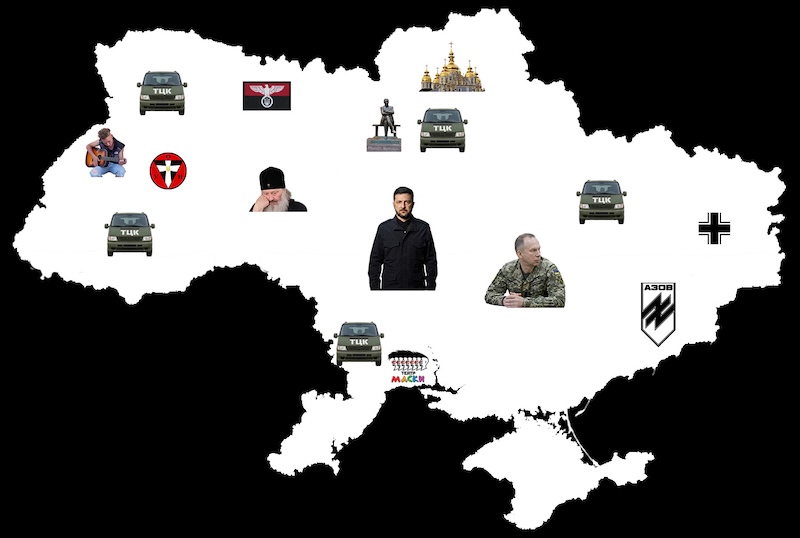
Within just 10–20 years, historians may no longer be able to say with certainty whom Russia was fighting in Ukraine if the army of its enemy was commanded by ethnic Russian Оleksandr Syrskiy, who was born in Russia, whose parents live in Russia, and who barely speaks Ukrainian, while the key government positions in Ukraine and the country’s most recognizable public figures were occupied by anyone except ethnic Ukrainians.
It is impossible to just come with weapons, seize someone else’s property, and declare it your own. Even if the power to do so exists, power by itself does not create ownership rights, and in order to legalize such a seizure. It is always necessary to call into question the existence of the lawful owner or prove that the owner has lost those rights.
Traditionally, the defining characteristics of the existence of a distinct people, in its collective legal sense, are considered to be a common language, culture, historical memory, traditions, distinctiveness, and religious heritage. Such characteristics cannot be destroyed in the course of a single battle or a single military campaign; therefore, their destruction or erosion is always a prolonged process.
That is precisely why the Ukrainian-Russian conflict has continued for so long, because it is not only about the military possibility of seizure, but about changing the public perception of good and evil, and consequently, of the victim and the aggressor. And as long as a people exists, the victim and the aggressor are obvious, but if a people is turned into a “radical ideology,” then everything is no longer so obvious.
And if, before 2022, the Ukrainian language, national clothing, traditions, cultural symbols, and religious institutions were perceived as indicators of the existence of Ukrainians as a separate national community, then today they are perceived exclusively as attributes of state affiliation that are used to form a common civic identity regardless of nationality and origin.
As a result, by 2026, a situation had emerged in which a Ukrainian could neither culturally nor legally prove the existence of the Ukrainian national group as a separate nationality, because the indicators that, in international practice, testify to the existence of a people as a separate national community in the collective legal sense — had been institutionally eliminated or stripped of their original meaning under the pretext of combating Russian influence.
And the absence of any legal status for the Ukrainian national group in the legislation of Ukraine, combined with the Russian Federation’s legal claims based on the denial of the existence of Ukrainians as a distinct national community and the assertion that they are merely a radical ideology of the Russian ethnic group, results in ethnic Ukrainians being placed, as a matter of law, in the position of a national minority within their own country, despite their demographic majority, historical continuity, and status as the titular national group — unless and until the opposite is established by law.
In an addtion, according to Article 1 of the Law of Ukraine No. 2827-IX “On National Minorities (Communities) of Ukraine”, adopted in 2022, national minorities are citizens of Ukraine who are not ethnic Ukrainians.
However, because Ukrainian legislation does not recognize ethnic Ukrainians as an independent collective legal category, this creates the possibility that ethnic Ukrainians themselves may be classified as a national minority. Although every individual has the right to determine his own ethnic identity, such self-identification does not, in itself, create a new collective legal category, since the right to self-identification belongs exclusively to individual, not collective, rights.
For example, in exercising his right to self-identification, a person may consider himself to be Slavic. However, such self-identification does not create an independent collective legal category under international law; legally, he will still belong to one of the recognized ethnic communities — for example, Russians, Poles, Czechs, Slovaks, Serbs, or Bulgarians.
Also, according to Article 1 of the new Law of Ukraine No. 2827-IX “On National Minorities (Communities) of Ukraine”, national minorities are recognized as ethnocultural communities within the civic composition of Ukraine. Moreover, nowhere in the text of this Law are they referred to either as a people in the collective legal sense or as part of the Ukrainian People in the collective legal sense, unlike the Indigenous Peoples of Ukraine, to whom such rights are expressly granted under the legislation of Ukraine.
Accordingly, they do not possess the right to self-determination, autonomy, or other collective rights of a people established under international law, which forms part of the national legislation of Ukraine pursuant to Article 9 of the Constitution of Ukraine. Consequently, the legislature deliberately places national minorities outside the legal status of a people recognized under international law, thereby excluding the application to them of international legal guarantees for the protection of their rights and freedoms.
The previous Law of Ukraine No. 2494-XII “On National Minorities in Ukraine”, adopted in 1992, guaranteed, in Articles 1 and 13, the realization of political, social, economic, and cultural rights both personally and through public associations of national minorities.
However, the new Law of Ukraine No. 2827-IX guarantees these rights only on an individual basis as the rights of persons belonging to national minorities (communities); however, for the duration of martial law and for six months after its termination, it temporarily restricts the right to peaceful assembly, provided for in Article 7, for national minorities (communities) that identify their affiliation by ethnic origin with an aggressor state.
And the only category to which this criterion corresponds within the jurisdiction of Ukraine is citizens of Ukraine of Russian nationality who fall under the legal status of a national minority (community), thereby imposing upon them an exclusive prohibition on peaceful assembly and de jure depriving exclusively representatives of the Russian ethnic group of the right to express their will and to self-determination.
According to Article 3 of this Law:
State guarantees in the sphere of realization and/or protection of the rights of citizens of Ukraine belonging to national minorities (communities).
Part 2 of this article:
The conduct by the state of a policy of integration provides for abstention from the policy and practice of assimilation of persons belonging to national minorities (communities) against their will, as well as protection of such persons from any actions directed at such assimilation.
But the absence in Ukraine of the legal status of ethnic Ukrainians as a collective category, while at the same time legal status exists for all other nationalities of the world, is precisely what creates the legal conditions for their forced assimilation into the Russian ethnic group, considering the Russian Federation’s legal claims that Ukrainians do not exist as a separate nationality, which constitutes a direct violation of the guarantees of Article 3 of this Law.
According to Article 5, Part 6 of this Law, the rights and freedoms of persons belonging to national minorities may be restricted in the interests of national security, ensuring territorial integrity and public order, preventing riots or crimes, protecting public health, as well as protecting the rights and freedoms of other persons, if such a restriction is necessary in a democratic society.
Also, according to Article 5, Part 6 of this Law:
When exercising and/or protecting the rights and freedoms of persons belonging to national minorities (communities), the popularization or propaganda of a terrorist state (an aggressor state) and its authorities, the Russian Nazi totalitarian regime, the symbols of the military invasion of Ukraine by the Russian Nazi totalitarian regime, representatives of the authorities of a terrorist state (an aggressor state) and their actions that create a positive image of a terrorist state (an aggressor state), justify or recognize as lawful the armed aggression of the Russian Federation as a terrorist state against Ukraine, or the occupation of the territory of Ukraine, shall be prohibited.
This is not the author’s interpretation, but a direct quotation from the law.
At the same time, Article 7 of Law No. 2827-IX guarantees the freedom of public associations and peaceful assemblies only for the realization of social, cultural, linguistic, and other public interests, but no longer provides for the realization of political rights through public associations, as was the case under the previous Law of Ukraine on National Minorities of 1992.
That is, first, the Ukrainian ethnic group, through deception, nationalist radicalization, non-recognition, and external denial, was transferred into the legal status of a national minority, legally making them “Russians,” and then, according to the law, their right to self-determination was restricted through a direct ban on peaceful assemblies, on the basis of their alleged “belonging” to the aggressor state.
This, in turn, makes it possible to raise the question of who exactly is the legitimate holder of the rights to the land, subsoil, natural resources, and territory of Ukraine, which, according to Article 13 of the Constitution of Ukraine, belong to the Ukrainian people, and not to the state, as in most countries of the world, if Ukrainians themselves are no longer recognized in the legal field as a separate nationality, but are regarded as a national minority within the Russian ethnic community.
At the same time, the only mention of the belonging of national minorities to the Ukrainian people in the collective legal sense is contained in the Preamble to the Constitution of Ukraine, which, after the adoption of the Law of Ukraine No. 3354-IX “On Law-Making Activity” in 2023, was removed from legal application as a rule of law pursuant to Article 38, Part 2, which states that the preambles of laws do not contain rules of law, and this also applies to the Constitution of Ukraine as Law of Ukraine No. 254к/96-ВР.
And if Ukrainians cease to be regarded as a separate people and are simultaneously declared to be part of the Russian people, then they lose not only the status of a separate nationality, but also the status of a separate victim of aggression, because, in such a construction, the aggressor and the victim legally merge into one people, and any actions against such a people may then be presented not as a violation of international law, but as a struggle against a dangerous ideology and the bearers of “illegal” views.
Consequently, in addition to the interest in radical nationalism on the part of the Russian Federation, Poland, Hungary, and Romania, since it enables the nullification of the right of ethnic Ukrainians to self-determination and thereby establishes the legal basis for the advancement of territorial claims, other ethnic groups within Ukraine itself, forming part of the Ukrainian People under the current legislation of Ukraine, likewise have a direct interest in this radical nationalism.
This is because they, too, eliminate one of their principal competitors with regard to the legal status of the Ukrainian People in the collective legal sense and, consequently, with regard to the status of the source of state authority, the legal successor, and the owner of the State’s territory, land, subsoil, and natural resources. This circumstance itself evidences the existence of a conflict of interests and interethnic confrontation within Ukraine. As the analysis that follows demonstrates, it becomes apparent that this is not merely a confrontation, but a full-fledged interethnic and interreligious conflict within the meaning of the principles and standards of international law.
In order to prevent speculation through comparative analogies, it is worth giving the example of Germany or France. Representatives of different nationalities also speak one language there, however, neither migrants nor citizens of other origins begin to wear the national clothing of Germans or French on a mass scale, use their national symbols, perform their traditional songs, publicly demonstrate their belonging to the corresponding nationality, and present its cultural characteristics as their own.
A language may be common, but national identity remains tied to a specific national group, and its cultural and religious institutions are not subjected to elimination or replacement. Moreover, neither Germany nor France has ever existed in a centuries-long bilingual environment where something that had been considered normal for centuries was suddenly declared a crime.
Moreover, no one denies the existence of the German or French ethnic group — neither within Germany or France themselves nor by their neighboring States, which do not claim that Germans or French are part of another ethnic group and do not lay claim to their historical identity.
In addition, comparisons with Germany and France based on the argument that those countries likewise have no special laws governing the legal status of ethnic Germans or ethnic French are legally untenable, since they have no internal institution of Indigenous Peoples that creates competition for the right to be recognized as the People of the State, while the territory, land, subsoil, and other natural resources belong to the State, but not to the People.
In their case, the legal status of the People in the collective legal sense is not the legal title to the ownership of the State’s territory, land, subsoil, and natural resources, but constitutes exclusively a political and legal category that determines the source of public authority, but not the subject of the right of collective ownership.
In Ukraine, however, Article 13 of the Constitution establishes that land, subsoil, and other natural resources belong to the Ukrainian People in the collective legal sense, the concept of which admits a dual interpretation and content: either civic — by passport, or ethnic — by blood, under which legal affiliation with the State is not even required. It is precisely this that confirms the exceptional nature of Ukraine’s legal framework and renders such comparisons legally incorrect.
Chronology of the Elimination of the Right of the Ukrainian National Ethnic Group to Exist
Nationalism in itself is a normal manifestation of national self-awareness; however, when it becomes the subject of claims by neighboring states, its perception and legitimacy begin to change, especially if those claims are connected with historical conflicts between peoples.
Since, in law, peoples may be constituted on either an ethnic or a civic basis, including populations made up of people of different nationalities united by a common territory, culture, traditions, language, religion, history, political identity or other shared characteristics, it was this principle that was invoked by the parties to the conflict in Donbas in 2014.
Russia persuaded the population of the region that it had a right to self-determination, and, with Russian backing, the population sought to exercise that right in practice. Moscow provided not only political and organizational support but also military assistance, which played a key role in the escalation and continuation of the conflict.
Despite criminal liability for separatism under Ukrainian legislation, Article 9 of the Constitution of Ukraine recognizes ratified international treaties as part of the national legislation of Ukraine. Consequently, the Charter of the United Nations and the International Covenant on Civil and Political Rights, which enshrine the right of peoples to self-determination, are also part of the legal system of Ukraine and are subject to application on an equal basis with national legislation.
It is precisely on this legal conflict that the entire conflict is built, where Russia refers to the right of Donbas, as a people in its civic composition, to self-determination, while Ukraine refers to territorial integrity and the provisions of the Criminal Code.
It follows that both the population of Donbas and Ukraine referred to the international norms and the laws of Ukraine in force that contradict each other, but as a “compromise” - Ukraine decided to take the path of force and to justify and glorify the elimination of separatists in every possible way, effectively proceeding from the fact that an armed person and one with the open support of Russia - no longer has any rights.
This is what served as the basis for the emergence of the volunteer battalions Aidar, Azov, Dnipro-1, Dnipro-2, Right Sector, and others…, while millions of photographs, publications, and video reports featuring their symbolism gradually formed the historical image of Ukraine not simply as a state that was defending itself, but as a state with a distinctly nationalist aesthetic.
But since these battalions were volunteer formations, most people at the time did not think at all about where this symbolism came from or what it meant. Before 2014, such phenomena effectively did not exist, and they themselves appeared for the vast majority of people practically out of nowhere. And against the background of the annexation of the Crimean Peninsula and the events in Donbas, people saw first and foremost volunteers who were going to defend the country, therefore the question of their symbolism simply did not have much significance for the majority.
For this reason, volunteer military formations with nationalist symbolism were presented as a necessary measure under the conditions of the conflict, while any rejection of nationalist movements was automatically interpreted as a rejection of Ukraine itself. And in order to demonstrate their loyalty to the state, support for the independence, sovereignty, and territorial integrity of the country - citizens were effectively required to accept and support the nationalist organizations, symbolism, marches, and public actions associated with this.
As previously noted, the financing of nationalist movements in Ukraine is undoubtedly in the interests of the Russian Federation, Poland, Hungary, and Romania, as it creates a plausible legal basis for legitimizing a military operation on the territory of Ukraine. It is likewise in the interests of other national groups within Ukraine that seek recognition as the Ukrainian People in the collective legal sense.
The more closely Ukrainian ethnicity becomes associated with radicalism and extremism, the easier it becomes to deny ethnic Ukrainians recognition as a distinct people under international law and, consequently, to challenge their historical claim to be the legitimate legal successors to the territory of Ukraine.
Meanwhile, in the official narrative, the overthrow of Yanukovych and the government coup began to be officially presented as the “Revolution of Dignity”, and it was precisely this interpretation that was entrenched through the media, the education system, memorials, and the state policy of memory, gradually displacing from the public space the very possibility of considering what had happened as a coup.
For future reference, it is also worth mentioning that, in parallel, beginning in 2014, active clearing and improvement of Jewish cemeteries began practically throughout Ukraine. For the majority of people, this looked unexpected and incomprehensible, since the sites that had remained abandoned for decades suddenly became the subject of increased attention. At the same time, the work was financed not from local budgets, but through targeted funding from external sources, coming through local self-government bodies.
Exactly where these funds came from and under which programs they were allocated remained unknown to the majority of the population.
At the same time, this is not an attempt to deny the right of Jewish communities to preserve historical memory and their own heritage, nor is it a denial of their historical presence on the territory of Ukraine, where, since the times of the Russian Empire, the Pale of Settlement existed — a territory beyond the boundaries of which Jews were prohibited from permanent residence, as a result of which numerous Jewish communities historically lived and continue to live on these lands.
This event is mentioned exclusively within the framework of the chronology of the processes under consideration and is necessary for understanding their origin and their connection with the subsequent events in Ukraine.
Meanwhile, under the pretext of combating the Soviet legacy, the mass renaming of streets and other objects began. The names of Heroes of the Soviet Union were replaced with the names of figures of the Ukrainian nationalist movement, including Bandera and Shukhevych, who for the majority of the population had never been national heroes, however, their glorification and the renaming in their honor were carried out as an element of the struggle against Russian influence and everything that was associated with the Soviet past.
As well as that, the Communist Party was legislatively banned, the use of Soviet symbolism was prohibited, and criminal liability for its public display was introduced, which many citizens perceived as the criminalization of a part of their own history, the history of their family, their past, and their biography.
At the same time, the mass renaming of settlements, streets, and other geographical names was taking place, the rules for the spelling of first names and surnames in official documents were being changed, and state registers and databases were being updated. All of this was presented as a struggle against Russian influence and the Soviet legacy. At the same time, citizens were effectively forced to transfer information about their rights and property into the new registers under the threat of being unable in the future to confirm their property rights and carry out legally significant actions.
However, the result was the destruction of documentary continuity between generations, when old documents, archival records, addresses, surnames, and other identifying information increasingly ceased to match the new registers. As a result, the confirmation of origin, family ties, the place of residence of ancestors, property rights, archival records, and the historical connection of a family with a specific territory not only became more complicated, but in many cases became extremely difficult or practically impossible without carrying out additional archival and legal procedures.
At the same time, the mass persecution of the Russian language appeared — beginning with social networks, first of all Facebook, and it was Facebook that became the principal instigator of radical nationalism, threats, calls for reprisals, and harassment of users simply because they conducted their activity and left comments in the Russian language. And it was not merely about insults or verbal altercations.
In very common cases, attempts were made to establish the identity of a person, find out his address or place of work, after which there followed proposals to “meet”, “talk”, “have coffee”, or “come over and sort it out”, which for many people created an atmosphere of constant fear and psychological pressure, when the use of the Russian language or the expression of one’s own opinion could lead to organized harassment and threats already beyond social networks. And when attempting to check the accounts of such ardent patriot-nationalists, as a rule, it turned out that they had been registered not even on the territory of Ukraine.
Moreover, under the pretext of combating Russian propaganda, Ukraine blocked access to Russia’s largest social networking platforms, VKontakte and Odnoklassniki, as well as to Mail.ru, the country’s leading email service, and Yandex, Russia’s dominant search engine. This made communication between residents of Ukraine and Russia effectively impossible and created an information blockade between the two countries. It was only as a result of that blockade that Facebook — the very platform on which incitement to ethnic hatred had flourished — became the most popular social network in Ukraine.
After some time, the first “language patrols” also appeared on the streets of Ukrainian cities — previously unknown public activists who conducted language raids, made remarks to citizens for the use of the Russian language, “issued fines”, and became the subjects of numerous publications, television reports, and memes on social networks.
At the same time, it was very noticeable that the greater part of the political leaders and public figures of that time continued to use the Russian language in unofficial circumstances, while in the public space demonstratively switched to Ukrainian, often with a noticeable accent. This contrast created a feeling of the artificiality of what was happening, when Ukrainian identity was increasingly perceived not as a natural part of everyday life, but as an element of a public political image, which it was necessary to constantly demonstrate to those around them.
The feeling of artificiality was intensified even more by the appointment in 2014–2015 to key state positions of citizens of Georgia, such as Mikheil Saakashvili, Alexander Kvitashvili, and Eka Zguladze, as well as their accelerated acquisition of Ukrainian citizenship, which for many looked like a demonstrative emphasis on a certain incompetence of the Ukrainian community, its inability to form its own personnel from its own environment and to organize itself independently, forming an evidentiary basis for future historians in favor of perceiving Ukrainian identity first of all as a political ideology rather than a national affiliation, the implementation of which involved citizens of various states.
Meanwhile, the Ukrainian language and Ukrainian culture increasingly came to serve as ideological markers of loyalty rather than indicators of a person’s national identity, to the extent that even former Georgian President Mikheil Saakashvili, after assuming a public office in Ukraine, publicly switched to speaking Ukrainian. Any deviation from Ukrainism, in turn, was perceived as a sign of betrayal, hostility, or affiliation with the opposing side.
In many cases, this was accompanied not only by public harassment and pressure, but also by direct physical violence. Among the best-known examples were the attacks by representatives of the National Corps and the Right Sector against Russian-speaking supporters of Shariy’s party, whose members and activists were repeatedly subjected to brutal beatings, ending up in hospitals with severe injuries, and in separate cases - even in intensive care.
At the same time, this is not about a legal or political assessment of the views of Anatoliy Shariy himself or his supporters. In this case, what matters is the very fact of the use of violence against citizens of Ukraine because of their political beliefs, regardless of how popular, correct, or erroneous anyone considers their views to be.
At the same time, the normalization and institutionalization of the killing of the so-called separatists was taking place, despite the fact that the Criminal Code of Ukraine provided for criminal liability for separatism exclusively by a court decision, and not extrajudicial mass killings. Nevertheless, participation in violence against one’s own fellow citizens was propagated and presented as a socially approved and heroic act, which contributed to the influx of thousands of volunteers into the ATO zone.
The Anti-Terrorist Operation (ATO) was the official name of the Ukrainian government’s operation conducted in the Donetsk and Luhansk regions from 2014 until April 30, 2018, after which it was officially replaced by the Joint Forces Operation (JFO), which continued until the large Russian invasion in 2022.
It is necessary to emphasize separately that the justificatory narrative about the presence on the territory of Ukraine of the Russian regular army or other armed formations cannot in itself serve as a justification for violence against the local population. Even in the presence of a foreign military presence, this does not cancel the requirements of the law and does not turn extrajudicial reprisals against citizens into permissible or lawful actions.
Meanwhile, national clothing, the Ukrainian language, national symbolism, traditions, and other elements of Ukrainian culture were presented not as the characteristics of a particular national group, but as a model of behavior that every loyal citizen of Ukraine was expected to follow.
As a result, the characteristics of the existence of ethnic Ukrainians as a separate nationality were so blurred and reduced to administrative affiliation with the state jurisdiction of Ukraine that their independent significance proved to be practically eliminated. In fact, not a single generally recognized characteristic remained that would unambiguously distinguish Ukrainians from other nationalities.
In fact, the state apparatus consistently blurred the characteristics that distinguished Ukrainians as a separate national community. However, this was presented as the strengthening of the unity of the people and civic equality, therefore no one saw the threat. Only later did it become clear that this very mechanism turned out to be one of the most effective instruments for the elimination of the national identity of Ukrainians.
As a result, it had already become impossible to distinguish ethnic Ukrainians from Russians, Moldovans, Greeks, Belarusians, Hungarians, Poles, Jews, and representatives of other nationalities, as everyone spoke Ukrainian, wore the same traditional clothing, ate borshch, and used the same national symbols, transforming Ukrainian nationality into a civic idea of unity.
This literally transformed Ukrainian nationality into the language of the Ukrainian state.
This, in turn, became an invaluable gift to the Russian Federation and its narratives of a single people and of ethnic Ukrainians not existing as a distinct legal category — that is, as a separate nationality. Within Ukraine itself, the Ukrainian language, national symbols, and other cultural attributes ceased to be distinguishing features of ethnic Ukrainians and instead became universal attributes of Ukrainian citizens of all nationalities, eroding the basic characteristics by which ethnic Ukrainians could prove their existence as a distinct community.
In 2018, under the pretext of combating Russian influence, FSB agent networks, Kremlin priests, and attaining the spiritual independence of Ukraine, the Orthodox Church of Ukraine (OCU) was created. The process of its creation took place with the active participation of state institutions and the highest political leadership of the country, which allowed many to perceive it not only as a religious project, but also as an element of state policy aimed at reducing the influence of the Ukrainian Orthodox Church, which in the public space was increasingly associated with Russian influence, the interests of the Kremlin, and the activities of FSB agent networks.
In 2019, the OCU received the so-called Tomos on independent church governance; however, the Tomos itself regulates matters of church jurisdiction, canonical recognition, and administrative subordination, but does not establish the historical, legal, or territorial continuity of the OCU from the Kyiv Metropolis.
The OCU is a newly created church structure that did not exist throughout the previous centuries and, consequently, does not possess its own thousand-year history, nor can it automatically be considered the legitimate legal successor of the Kyiv Metropolis, which existed on this territory for more than one thousand years.
They are using the history of the old Kyiv Metropolis to justify the Orthodox Church of Ukraine’s claim to continuity. But this is a substitution of concepts. The Tomos gives the new church canonical recognition, not a historical right to inherit the legacy of the ancient Kyiv Metropolis.
Otherowrds, as long as parishioners remain in the Ukrainian Orthodox Church, they can claim continuity with the old church tradition and its historical heritage. But once they move to the Orthodox Church of Ukraine, they can still hold religious services, but they lose the claim to territorial continuity and inheritance.
For this reason, the connection with the thousand-year church tradition was replaced by membership in a new organization, which broke the historical connection and deprived it of the possibility of using the thousand-year history as evidence of the right to consider this territory its historical land. However, the majority of the representatives of the indigenous population did not even realize the consequences of such a substitution.
If the Ukrainian Orthodox Church is weakened by labels of Moscow influence, while the Orthodox Church of Ukraine (OCU) does not possess historical continuity or a connection with this territory, then the oldest religious structures on the territory of Ukraine become, without any competition, precisely the Jewish religious institutions. This leads to the destruction of the historical connection of ethnic Ukrainians with this territory, as well as to the loss of one of the key elements that was used as evidence of their centuries-long presence on this land.
And the restoration of Jewish cemeteries, memorials, and burial sites throughout the territory of Ukraine, which began after 2014 and was mentioned earlier, also acquires an entirely different meaning, since it forms a single logical framework for establishing and legitimizing the right to the heritage and territorial continuity of this territory exclusively for the Jewish community.
It should be explained that the Catholic and Greek Catholic structures also possess their own heritage and historical continuity. However, their influence has historically been limited to particular regions of Ukraine. Therefore, if the Ukrainian Orthodox Church is weakened and the Orthodox Church of Ukraine (OCU) lacks historical continuity, then in central and eastern Ukraine it is precisely the Jewish religious communities that become the closest bearer of historical continuity.
In 2021, the Law on Indigenous Peoples was adopted, which legitimized the Karaites and Krymchaks as indigenous peoples of Ukraine. At the same time, the State of Israel recognizes the Karaites and Krymchaks as Jews in the ethnic, rather than the civic sense, while the overwhelming majority of representatives of these communities reside specifically in the State of Israel and have the right to repatriation to the State of Israel. Consequently, they cannot be considered an indigenous people of Ukraine even according to the criteria of very own Law No. 1616-IX itself, since they have their own state formation outside Ukraine, which directly contradicts Article 1 of the same law.
At the same time, the public was not informed that, according to official data, approximately 50,000 Karaites reside in Israel alone, according to information from their open sources, while the conduct of a population census within the Karaite community is restricted by religious prohibitions, as a result of which its actual population cannot be reliably determined and cannot be objectively confirmed or disproved.
The differences between Karaites, Krymchaks, and Jews are regarded as intercommunal, not interethnic, which allows members of the Jewish community to invoke the right to free national and religious self-identification, as guaranteed by Article 300 of the Civil Code of Ukraine, Article 3 of the Council of Europe Framework Convention for the Protection of National Minorities, Article 8 of the European Convention on Human Rights, Article 27 of the International Covenant on Civil and Political Rights, and Article 35 of the Constitution of Ukraine on freedom of thought and religion.
And from a legal point of view — this is a mechanism for legalizing an unlimited population size by reference to guarantees of freedom of religion.
The Law on Indigenous Peoples also recognized the Crimean Tatars as an indigenous people. At the same time, however, it effectively blocked the mechanisms for their collective representation, since Ukraine has not ratified ILO Convention No. 169 (the Indigenous and Tribal Peoples Convention, 1989), while the traditional representative body of the Crimean Tatar people, the Mejlis of the Crimean Tatar People, until the information scandal and public outcry triggered by the Voice of Ukrainians project on social media, not only did not have legal status in Ukraine itself, but legislative mechanisms for its legalization did not even exist.
Only later, on April 2, 2026, former president Zelensky signed Presidential Decree No. 293/2026, by which he instructed the Cabinet of Ministers of Ukraine to urgently resolve the issue of granting the Mejlis of the Crimean Tatar People the legal status of the representative body of the Crimean Tatar people.
At the same time, the Karaites and Krymchaks are protected by the State of Israel, the Law of Return, international and national mechanisms for combating antisemitism, international Jewish organizations, as well as a network of Jewish public, religious, charitable, and representative organizations, and therefore, from both a legal and practical perspective, do not even require Ukraine to ratify ILO Convention No. 169.
In addition, the Law on Indigenous Peoples eliminated the civic composition of the Ukrainian people, enshrined in the Declaration of State Sovereignty of Ukraine and in the Preamble to the Constitution. For the first time, the category of the Ukrainian people in the collective legal sense was introduced directly by a legal norm, which created a legal collision and legal asymmetry, changing the very principle of determining the composition of the Ukrainian people.
If previously the composition of the Ukrainian people was determined through the Preamble to the Constitution, which states that the Constitution is adopted on behalf of the Ukrainian people — citizens of Ukraine of all nationalities — and this very formula was used to determine the composition of the Ukrainian people, then after the adoption of the Law on Indigenous Peoples that formula lost its legal basis, since the law introduced a category of the Ukrainian people in the collective legal sense that may exist independently of Ukrainian citizenship and is based on ethnic, rather than civic, affiliation.
As a result, a legal asymmetry arose in which citizens of Ukraine of all nationalities continued to be recognized as the Ukrainian people only at the level of declarative provisions that contain no mechanisms of implementation and no legal consequences for their non-compliance, whereas indigenous peoples received the status of the Ukrainian people in the collective legal sense directly in the law and in norms of direct effect.
In 2022, the invasion of the Russian Federation began under the political slogans of denazification and demilitarization. Officially, it is called the SMO, since the Russian leadership does not recognize the existence of Ukrainians as a separate nationality and regards them as part of the Russian people that has been subjected to the influence of radical nationalist ideology.
In response to this, the Ukrainian leadership effectively declares the Russian language the language of the aggressor, collaborationism, and sabotage, and Russian culture the main internal enemy of the state.
If previously pressure on the Russian language and Russian culture was expressed in the form of propaganda, street actions, the activities of various activist groups, television speeches, and threats on social networks, then after 2022 these processes are already being carried out at the state level with the direct participation of the police and the SBU.
For listening to Russian music in private houses and apartments, the police were increasingly called, while for publicly performing songs in Russian, people were forced to record public apologies on camera.
Thus, in Lviv, after a street performance of a song by Viktor Tsoi, a Soviet rock musician and one of the most famous Russian-language rock figures of the USSR, the Security Service of Ukraine (SBU) forced a young man to publicly apologize on camera.
Thus, the use of the Russian language increasingly became a reason for conflicts, dismissals from work, detentions, arrests, and threats of criminal prosecution. And all of this formed the impression that the struggle was being waged not only against the Russian Federation, but also against the Russian language and Russian culture as such.
Instead of uniting the population regardless of language or origin during wartime, state policy increasingly divided society. For millions of Russian-speaking citizens and representatives of national minorities, these developments were perceived as the forced imposition of radical Ukrainization, while any disagreement was automatically associated with serving the aggressor, justifying Russian aggression, or disloyalty to the state.
As a result, a significant part of the population found itself compelled to constantly prove its political loyalty, while the policy officially presented as protecting the state in practice only deepened internal divisions and further escalated the conflict.
In May 2022, Ukraine also adopted Law No. 2215 On the De-Sovietization of the Legislation of Ukraine, under which, under the pretext of eliminating the Soviet legacy, the Constitutions of the Ukrainian SSR of 1919, 1929, 1937, and 1978, the Law On the Economic Independence of the Ukrainian SSR, the Land Code of the Ukrainian SSR, the acts of the land reform, and a number of other fundamental legal instruments that had ensured the legal and historical continuity between the Ukrainian SSR and modern Ukraine were removed from the legal framework.
At the same time, the continuity of the state, its territory, borders, property, and international obligations was preserved in full, whereas the legal continuity of the Ukrainian people, in the collective legal sense, as a collective legal subject was effectively eliminated. The legal provisions linking modern Ukraine with the previous state legal system were repealed, yet no new legislation establishing the legal status, legal subjectivity, and continuity of the Ukrainian people was adopted. As a result, the state retained all the rights and assets of its predecessor, while the people were left without their own normative legal basis for continuity.
Likewise, in 2022, a new Law on National Minorities was adopted, despite the fact that the corresponding law had already existed. Officially, this was explained by the requirements of European integration and by bringing the legislation into conformity with European standards.
However, the new law established a legal framework under which national minorities do not possess the right to self-determination and cannot put forward demands for the creation of autonomies. Moreover, national minorities are not referred to anywhere in the law as a people or as part of the people, but are defined exclusively as cultural communities within the body of citizens of Ukraine.
Furthermore, beginning in 2022, under the pretext of combating “Kremlin agents” and the “FSB network,” amendments were introduced into the Law of Ukraine On Freedom of Conscience and Religious Organizations No. 987-XII, creating a legal mechanism for the liquidation of the Ukrainian Orthodox Church as a religious organization, its removal as the canonical legal successor of the Kyiv Metropolis, and the termination of its right to use churches, monasteries, land, and other religious property.
As the public justification for these amendments, the ruling regime of Ukraine referred to the results of searches conducted in certain monasteries and involving certain members of the clergy, during which, according to its statements, weapons, pro-Russian literature, symbols, and other materials were allegedly discovered and treated as evidence of ties between certain representatives of the UOC and the Russian Federation.
Legally, this is a mechanism for eliminating a competitor in the issue of territorial succession between the Ukrainian Orthodox Church and Jewish religious institutions. And if the Ukrainian Orthodox Church is prohibited and liquidated, then the oldest religious institutions in Central and Eastern Ukraine become precisely the Jewish religious institutions. Consequently, they can now rely on this historical continuity and claim legitimate historical rights to this territory.
For the clarity of the horror of what was taking place and the scale of the religious persecution of Orthodox Christianity, it should be emphasized that, after the beginning of the Russian invasion, Orthodox religious processions on the territory of Ukraine were prohibited under the pretext of martial law, whereas the celebration of the Jewish New Year, Rosh Hashanah, in Uman, with the participation of more than 35,000 Hasidic pilgrims, was held annually without any restrictions.
Moreover, while Ukrainians were prohibited from holding religious processions and school graduation ceremonies, Hasidic pilgrims were constantly protected by the National Police of Ukraine — with the extraterritorial participation of Israeli security forces.
In 2023, Law of Ukraine No. 3354-IX On Law-Making Activity was adopted, Article 38, Part 2 of which established a new technique for the interpretation of the laws of Ukraine, according to which the preamble of a law does not contain norms of law. Since the Constitution of Ukraine has the legal nature of a law and is Law of Ukraine No. 254k/96-VR, this rule of interpretation also applies to its preamble.
Whereas previously the question of the legal significance of the preamble to the Constitution had remained a matter of debate and had no substantial practical significance for civil society, following the introduction into Ukrainian legislation of the categories of indigenous peoples and national minorities, as well as the absence of any analogous law for the titular majority — ethnic Ukrainians — this issue acquired critical importance, because the preamble ceased to be regarded as a legal source for determining the composition of the Ukrainian People, to whom, pursuant to Article 13 of the Constitution of Ukraine, belong the land, the territory, the subsoil, and the natural resources of Ukraine.
As a consequence, as a result of the adoption of this law, both ethnic Ukrainians and national minorities were massively legally robbed, since their belonging to the Ukrainian People remained only in a declaratory form, whereas the indigenous peoples obtained the status of a people established by law in norms of direct legal effect.
Although, according to generally accepted constitutional practice around the world, a constitutional preamble has always been declaratory in nature and has never contained binding legal rules. Instead, it has traditionally served as the constitutional reference for defining the composition of the people within the civic model of society, where all groups enjoyed equal legal status.
As long as no separate legal categories compete for the legal status of the people, this creates no legal problem because everyone exists under the same constitutional declaration. However, once the institution of indigenous peoples is established by a binding rule of law while another people continues to exist only in a constitutional declaration, the legal balance changes fundamentally.
It is the same as issuing one group an official certificate of property title, which automatically confirms the status of the owner, creates legal mechanisms for the protection of that right, and turns the property into a fully recognized asset that can be defended in court, transferred, inherited, used as collateral, and taken into account in property legal relations, while leaving the other group with only a receipt stating that this property is also considered their property.
Such a receipt can be used only as an auxiliary reference or guideline for a court, witnesses, or other participants in the process, but not as independent confirmation of property title. It may indicate someone’s position or intentions, but by itself it does not establish the right, does not confirm its existence, and does not create mechanisms for its protection.
At the same time, the image of the ethnic Ukrainian is being marginalized. In the public sphere, there are almost no positive and authoritative representatives of Ukrainians, while scandalous, criminal, or marginal figures more often become widely known, creating a distorted and discrediting image of the Ukrainian national community.
Remarkably, since the beginning of the Russian invasion, three key positions in Ukraine have, for some reason, been held by representatives of the Jewish community, which, according to official statistics, makes up only 0.2% of the population: the President, the Head of the President’s Office, and the Minister of Defense. This further reinforces the historical image of Ukraine as a Jewish state fighting for its independence from Russia.
This could be dismissed as mere coincidence were it not for the combination of actions associated with the clearing of Jewish cemeteries and the installation of menorahs in the central squares of Ukrainian cities — for the first time in the history of independent Ukraine — precisely during Russia’s armed invasion and under martial law, which underscored the dominance and superiority of the religious institutions of Judaism over Orthodoxy.
Taken together with the open repression of the Ukrainian Orthodox Church, the prohibition of religious processions, and the legislatively mandated rescheduling of the celebration of Christmas, this pointed to the existence of interreligious and interethnic tensions, as well as to the emergence of a conflict over the criteria of collective Ukrainian identity — namely, over the question of who is entitled to act as the bearer of the Ukrainian people and to represent it in the legal and historical sense.
This caused an unprecedented wave of outrage, indignation, and a sense of deep injustice in Ukrainian society, which, however, was almost immediately shifted by the ruling regime into the sphere of manifestations of xenophobia and antisemitism.
Moreover, under the pretext of the Russian invasion and the introduction of martial law, Ukraine officially invoked the legal regime of derogation in accordance with Article 15 of the European Convention on Human Rights and Article 4 of the International Covenant on Civil and Political Rights, notifying the Council of Europe and the United Nations that the Ukrainian state was unable to guarantee the observance of a number of fundamental rights and freedoms. However, the source of aggression, violence, arbitrariness, and ultimately total terror proved to be not the actions of the Russian armed forces, but the state apparatus of Ukraine itself.
Tens of thousands of videos of violent mobilization, abductions, beatings, coercion of civilians involving military personnel, reports of deaths, abuses, and arbitrariness continue to circulate on social media, creating for many people a sense of injustice originating from the Ukrainian state itself.
At the same time, all of this is accompanied by the absence of any noticeable reaction from oversight bodies, the prosecutor’s office, and other state institutions, creating the impression of complete impunity. As a result, these images come to dominate the information space, shaping the image of a repressive and violent system.
All of this turns the population against Ukraine itself, and as a result, many people begin to hate the Ukrainian state more than Russia, because they encounter the actions of the Russian armed forces only locally, whereas they encounter the actions of the Ukrainian state repressive institutions every day and everywhere.
And more and more Ukrainian citizens are therefore beginning to perceive Ukraine not as a victim of aggression, but as a tyrannical and dictatorial regime whose repressive apparatus is financed by donor countries without any human rights safeguards or requirements to respect fundamental human rights, thereby creating a self-perpetuating cycle of the complete or partial destruction of a people through the deprivation of its legal subjectivity, legal protection, and collective identity.
According to Ukraine’s official notifications of derogation submitted to the Council of Europe and the United Nations, the Ukrainian state has officially derogated from its obligations to guarantee the right to liberty and personal security, the right to a fair trial, the right to respect for private and family life, freedom of expression, freedom of peaceful assembly and association, the right to an effective remedy, protection against discrimination, freedom of movement and the right to leave the country, procedural guarantees against expulsion and deportation, protection against double prosecution for the same offence, the right to recognition as a person before the law, the rights of minorities, as well as other fundamental rights and constitutional guarantees.
The most terrifying measure, however, was the closure of Ukraine’s borders to Ukrainian men by a resolution of the Cabinet of Ministers instead of a law, which, under Article 64 of the Constitution of Ukraine, constitutes one of the gravest violations of the constitutional order, since restrictions on fundamental rights and freedoms may be imposed exclusively by law.
If the legal status of indigenous peoples and national minorities, granted to them in 2021–2022, was justified by the need to protect vulnerable communities, their language, culture, identity, and collective rights, then what can justify the absence of an equivalent legal status for ethnic Ukrainians, including those living in the occupied territories of Ukraine, where they are in the greatest need of legal protection — remains unknown.
From a legal perspective, however, such inaction on the part of Ukraine may be regarded as institutionalized complicityin their assimilation into the Russian people and, consequently, their transformation de jure into the legal status of a “national minority” which, under Ukrainian law, does not possess the right to self-determination or territory, thereby legitimizing the Russian Federation’s narrative that this is not a war against a distinct people, but rather the denazification of the “wrong Russians” who adhere to a “radical ideology.”
Moreover, the absence of a legal status for ethnic Ukrainians, their deliberate legal exclusion from the Ukrainian people through legislative mechanisms adopted between 2021 and 2023, as well as the institutionalized complicity of Ukraine in their forced assimilation into the Russian people, may indicate the existence of a competitive struggle between ethnic communities for the very right to be recognized as the Ukrainian people.
This may explain why Ukrainians around the world are rarely granted political asylum or refugee status under the 1951 Refugee Convention. Instead, they are placed under different forms of temporary or collective protection.
The asylum process requires written statements, an individual review of each case, and a written record of the applicant’s ethnic identity. If it is later claimed that asylum was given not to Ukrainians as a nation with the right to self-determination and international protection, but to a group presented as supporters of a radical or Nazi ideology, this could raise questions about helping, hiding, and protecting people who may later be described as supporters of an extremist or Nazi ideology, or as a threat to the international legal order.
For this reason, it may be safer for the international community to use temporary and collective protection. These systems do not require written testimony, a written record of ethnic identity, or legal recognition of Ukrainians as a separate national community. This leaves room for different political, legal, and geopolitical interpretations in the future, although this may raise suspicions of a global conspiracy and a deliberately orchestrated conflict, that is not the subject of this article.
At the same time, since 2022, the Jewish religious symbol, the menorah, has been prominently displayed in the central streets and squares of Kyiv and other Ukrainian cities. This appeared to be a demonstration of the dominance and superiority of the Jewish religious tradition over other religions.
Meanwhile, Orthodox religious processions were banned because of martial law, Orthodox priests were arrested, churches were forcibly seized, and the date of Christmas celebrations was changed. Because of this, the menorahs were seen not simply as Jewish religious symbols, but as a demonstration of the dominance and superiority of the Jewish religious tradition over other religions and of its special status in public life.
And no one, either in the international community or within the country itself, asks why the role of the principal promoter and inciter of radical Ukrainian nationalism is played by someone who is not even Ukrainian by ethnicity is Volodymyr Zelenskyy, while it is ethnic Ukrainians who are ultimately branded as Nazis.
The underlying issue, however, is that the more closely Ukrainian identity becomes associated with radical nationalism, the easier it becomes to deny ethnic Ukrainians the right to be recognized as the legitimate Ukrainian People, possessing the right to territory, sovereignty, and self-determination. In this way, the radicalization of Ukrainian identity becomes an ideal instrument for eliminating competing claims to the very right to be recognized as the Ukrainian People.
And may also explain why Zelenskyy and Ukraine’s top political leadership openly rejected traditional official clothing and the classical state protocol. The constant use of a specific style of clothing creates a visual image of the totalitarian government that future historians will judge through photographs, video recordings, symbols, and other visible attributes when assessing the entire political regime.
If, decades from now, historians examine the photographs, video recordings, and other visual materials from this period, they are likely to come away with the image of a regime whose visual aesthetic bears a far closer resemblance to that of Nazi Germany than to that of a democratic state fighting for its independence.
It is precisely for this reason that Zelensky’s initiative and participation in events commemorating figures of the Ukrainian nationalist movement, the reburial of Andriy Melnyk, a leader of the Organization of Ukrainian Nationalists (OUN), the conferral on a unit of the Special Operations Forces of the honorary title “named after the Heroes of the UPA,” referring to the Ukrainian Insurgent Army (UPA) and the OUN—organizations associated with periods of collaboration by some of their members with Nazi Germany during the Second World War and widely linked by historians to the Volhynia massacres, in which tens of thousands of Polish civilians were killed—which caused a diplomatic scandal with Poland and the Czech Republic and official condemnation by the European Parliament, as well as other similar actions, are regarded as elements of an interethnic conflict, the discrediting of the Ukrainian ethnic community, the incitement of interethnic hostility, and the creation of an image of Ukrainians not as a people or a nationality, but as bearers of a radical ideology that must be opposed and condemned.
Moreover, he does so on behalf of Ukrainian ethnic culture, despite having no legal right to represent it.
And, it should be noted that, by Law No. 3354 on Lawmaking Activity and by the absence of a separate law on the legal status of ethnic Ukrainians, Zelensky personally excluded ethnic Ukrainians from the composition of the Ukrainian people in the collective legal sense. Therefore, he no longer has the authority to speak on their behalf as on behalf of the people in its civic composition. Since he himself is not an ethnic Ukrainian by nationality, he has no legal right to speak on behalf of ethnic Ukrainians in their national composition.
It could be argued that, in exercising his right to self-identification, Zelenskyy is legally entitled to identify himself as an ethnic Ukrainian. However, throughout his entire public career, he has never made a public statement identifying himself as such. On the contrary, he has repeatedly and expressly identified himself as Jewish in his own public statements. F
And when, during the ongoing Russian invasion in 2025, Kyiv schoolchildren are forcibly taken on excursions not to the Holodomor Museum — a memorial dedicated to the millions of Ukrainians who died in the man-made famine of 1932–1933 — or to the Kyiv Pechersk Lavra — the historic religious institution of Ukrainian Orthodoxy — but to the Babyn Yar Memorial Center — a museum and memorial dedicated to the victims of the Holocaust — and then to the Kyiv Synagogue — the religious institution of Judaism, where a personalized chair of Volodymyr Zelenskyy has been installed — that causes bewilderment and indignation not only among parents but also among the children themselves, who do not understand why they are being taken there at all, then the question of his identity — ceases to be a matter of speculation and is determined by the totality of his own public statements and actions.
Under Article 5 of the Constitution of Ukraine, the only source of power is the people, not the citizens. Therefore, citizens themselves do not have any power and cannot delegate it. And under Article 38 of the Constitution of Ukraine, citizens participate in elections and are elected to public office. However, they do so on behalf of the people. This is possible only where there is a legal connection between the citizen and the people — where the same individual simultaneously exists both as a citizen and as a member of the people.
If ethnic Ukrainians and national minorities were removed from the composition of the Ukrainian people in the collective legal sense as a result of the legislative reform introduced by Law No. 3354 on Lawmaking Activity, which removed the Preamble to the Constitution from legal application as a rule of law — the only place in the entire legislation of Ukraine where the citizens of Ukraine were recognized as the Ukrainian people—then they can no longer delegate their power, because they exist exclusively in the legal status of citizens and natural persons, but no longer possess the legal status of the people.
In addition to the ceremonial honoring of radical nationalists from the OUN and UPA, in June 2026 a monument to Mikhail Bulgakov, a Kyiv-born writer whose works in Russian formed part of Ukraine’s cultural heritage and reflected the centuries-long presence of the Russian language within its cultural space, was dismantled, while the very existence of such figures demonstrated that the Russian language in Ukraine was not merely an external phenomenon, but an integral part of its historical and cultural expression inside the country.
And Zelenskyy’s signing, on June 12, 2026, of the law excluding the Russian language from the European Charter for Regional or Minority Languages became the final confirmation of the thesis that Ukraine is not fighting Russian aggression, but is institutionally destroying Russian culture, which, for historians, will constitute unequivocal evidence that the regime in Ukraine was fighting Russian culture rather than Russian aggression, and therefore that it was a Nazi regime rather than a state defending its sovereignty.
In that case, ethnic Ukrainians may be regarded exclusively as citizens of Ukraine, while the path to the status of the Ukrainian people in the collective legal sense and the sole legitimate successor on this territory becomes open to other peoples and nationalities recognized by Ukrainian legislation and possessing the legally established status of a people within the jurisdiction of Ukraine, namely the Jewish and Crimean Tatar diasporas.
According to Article 58 of the Constitution of Ukraine, a law has no retroactive effect. Therefore, Law No. 1616-IX On the Indigenous Peoples of Ukraine, adopted in 2021, cannot be applied retroactively to the events of 2014 in Crimea or used as a legal basis for their protection. Accordingly, the peoples recognized by this law cannot be regarded as the legitimate victims in the context of the Crimean Peninsula on the basis of a legal status that came into existence only seven years after those events.
For the same reason, Russia cannot be held legally responsible for the oppression of an “indigenous people” that did not legally exist at the time of the annexation. The situation is different, however, with respect to mainland Ukraine, because this law has been in force there since the moment of its adoption.
Crimean Tatars are, in practical terms, confined to the territory of the Crimean Peninsula, while their representative institution, the Mejlis of the Crimean Tatar People, has been designated by the Russian Federation as an extremist organization. At the same time, no separate legal status of the Mejlis has, to date, been formally established under Ukrainian law. The instruction contained in Presidential Decree of Ukraine No. 293/2026 of April 2, 2026, to resolve the issue of granting the Mejlis the legal status of a representative body does not itself constitute the conferral or statutory recognition of such status and does not establish that such status has legally come into existence.
And the Karaites and Krymchaks, who in Israel are regarded as part of the Jewish people in the ethnic, but not the civic, sense, the overwhelming majority of whom reside in Israel, have received the exclusive legal status of the Ukrainian people, together with their own representative bodies and collective rights established by law throughout the entire territory of Ukraine under its jurisdiction, even without holding Ukrainian citizenship, since the connection with the territory in this case is based not on a civic-administrative criterion, but on an ethnic one.
By 2025, Law No. 4700-IX had become the final stage in dismantling the historical continuity of the Ukrainian people by replacing the people, as the founding authority of the state, with a group of Members of Parliament who were granted the official status of the founders of modern Ukraine. In doing so, it ultimately formalized the substitution of the collective source of statehood with individual natural persons.
Such a legislative framework became necessary following the emergence of the indigenous peoples of Ukraine, who now exist independently of Ukrainian citizenship but did not legally exist when the Constitution was adopted. Consequently, the formula contained in its Preamble — “on behalf of the Ukrainian People — citizens of Ukraine of all nationalities” — can no longer be relied upon as a universal criterion for determining the composition of the Ukrainian People, since that composition has been altered. It may now include persons who do not even possess Ukrainian citizenship and who were not legally recognised at the time, while citizens of Ukraine, in their present composition, have been excluded from it.
Further evidence that the matter concerns an interethnic conflict, rather than a purely political or territorial dispute, was provided by the public response to materials published by the Voice of Ukrainians project concerning the absence of a legally recognized status for ethnic Ukrainians under Ukrainian law.
Beginning in March 2026, the project’s materials received millions of views on YouTube, TikTok, and Telegram, generating widespread public attention. Despite the removal of publications and the blocking of accounts, discussion of the issue continued to spread and attract increasing attention.
For the first time in Ukraine’s history, this public response on social media led to the registration of a draft law concerning the legal status of ethnic Ukrainians. The draft, however, contained provisions that were incompatible with international law from the outset, thereby precluding its lawful adoption.
Thus, on 27 March 2026, Draft Law No. 15103 on amendments to the Law of Ukraine On the Indigenous Peoples of Ukraine was registered in the Ukrainian Parliament. It proposes recognizing ethnic Ukrainians as the titular indigenous people of Ukraine without the right to self-determination and their own representative institutions, which violates Article 1 of the Charter of the United Nations, Common Article 1 of the International Covenant on Civil and Political Rights and the International Covenant on Economic, Social and Cultural Rights, Article 27 of the International Covenant on Civil and Political Rights, Articles 1 and 2 of the International Convention on the Elimination of All Forms of Racial Discrimination, as well as Articles 2 and 5 of the United Nations Declaration on the Rights of Indigenous Peoples, thereby rendering its adoption in its current form legally impossible.
On 8 May 2026, Draft Law No. 15223 on Amendments to the Law of Ukraine On the Indigenous Peoples of Ukraine concerning the recognition of the Gagauz as an indigenous people of Ukraine was registered in the Verkhovna Rada. The draft law provides for the inclusion of the Gagauz in the statutory list of indigenous peoples of Ukraine.
Taken together, the registration of Draft Laws No. 15103 and No. 15223, the legislative elimination of the historical and territorial continuity of ethnic Ukrainians, and the persecution of the Ukrainian Orthodox Church against the background of the celebration of Rosh Hashanah in Uman, the rescheduling of Christmas, and the public lighting of menorahs on Maidan provide evidence of the existence in Ukraine of both an interethnic and an interreligious conflict extending beyond the limits of a purely political or territorial dispute.
As a result, as was to be expected, on 16 June 2026, the relevant committee of the Ukrainian Parliament rejected Draft Law No. 15103. This confirms that the submission of the draft law by deputies of the “Servant of the People” party was a pre-emptive tactical move aimed at reducing public tension rather than at its actual adoption and granting ethnic Ukrainians an independent legal status.
Another confirmation that public tension had already escalated into a social explosion that had to be suppressed in some way was that, as early as April 2026, Zelensky signed Law No. 2037-IX On Amendments to Article 161 of the Criminal Code of Ukraine for the Implementation of the Provisions of the Law of Ukraine “On Preventing and Combating Antisemitism in Ukraine”, which had remained unsigned for more than four years after its adoption by the Ukrainian Parliament in February 2022.
The signing of this law coincided with the peak wave of public resonance on social media, accompanied by a surge of dissatisfaction and outrage over the deprivation of ethnic Ukrainians of their status as a people and of their collective legal subjectivity through legislative reforms carried out during martial law. This most likely became the reason why the law was signed precisely at that moment, in order to shift any criticism of those legislative reforms from the political and legal sphere into the sphere of criminal law, and discussion of the interethnic conflict into accusations of antisemitism.
This may serve as one of the clearest pieces of evidence of the existence of legal apartheid, under which, in the complete absence of any legally established status for ethnic Ukrainians and even the most basic mechanisms for their collective protection, Volodymyr Zelensky signs a law introducing additional guarantees and special protection mechanisms exclusively for the Jewish community.
Thereby treacherously violating the Declaration of the Rights of Nationalities of Ukraine No. 1771-XII, Article 24 of the Constitution of Ukraine, Article 161 of the Criminal Code of Ukraine on the inadmissibility of violating the equality of citizens on the grounds of national origin, Article 26 of the International Covenant on Civil and Political Rights, Article 14 of the European Convention on Human Rights, Articles 1 and 5 of the International Convention on the Elimination of All Forms of Racial Discrimination, as well as the fundamental principle of equality and non-discrimination underlying both national and international law.
But if, as a result of Zelensky signing Law No. 3354-IX, the Preamble to the Constitution, as the only place in the entire body of Ukrainian legislation where the citizens of Ukraine were expressly recognized as the Ukrainian People, was removed from legal application as a rule of law through the introduction of a new rule for interpreting the preambles of laws, according to which the preamble of a law does not contain legal norms, then the Preamble to the Constitution lost its ability to determine the composition of the Ukrainian People, to whom, under Article 5 of the Constitution, power belongs as its sole source, and thus a legal vacuum arises.
Citizens of Ukraine who elected him lost their legal belonging to the Ukrainian People in the collective legal sense, while the recognized indigenous peoples neither elected him nor delegated power to him, because at the time of his election they did not even legally exist.
Consequently, the problem is not even that Ukrainians consider his power to be illegitimate, but that the source of that power was eliminated by his own hand as a “side effect” of his own political reforms, including the signing of the law on combating antisemitism.
And if a legitimate source of power does not exist, then the power itself does not exist. Therefore, all subsequent laws and decrees signed in his name lack legal validity, including the law on combating antisemitism, which, in such circumstances, constitutes nothing more than an instrument for suppressing a social explosion through the criminalization of freedom of speech and expression, as well as the introduction of criminal-law mechanisms of liability for their expression.
According to paragraph 1 of Section XIV, “Final Provisions,” of Law No. 3354-IX, the said Law enters into force on the day following its official publication, but is brought into effect only one year after the termination or cancellation of martial law in the territory of Ukraine, which demonstrates the deliberate targeting specifically of the Preamble to the Constitution and constitutes a mechanism for circumventing Article 157 of the Constitution of Ukraine, which prohibits amendments to the Constitution during martial law.
However, since the Ministry of Justice of Ukraine — already officially refers to the provision stating that the preamble to a law does not contain rules of law in its responses to requests for access to public information, it may therefore be concluded that this Law has already both entered into force and been brought into effect, while the above-mentioned provision is formally used solely to circumvent Article 157 of the Constitution of Ukraine.
But the particular cynicism of Zelenskyy’s policy and the Law on Combating Antisemitism also lies in the fact that the term “antisemitism” is tied to Jewish nationality, whereas the term Ukrainophobia, by Law of Ukraine No. 3005-IX of 21 March 2023, was personally tied by Zelenskyy himself to the denial of the legal subjectivity of the Ukrainian State and the Ukrainian nation, to resistance against the subjugation, exploitation, and assimilation of the Ukrainian People, and to contempt for the distinctive ethnocultural characteristics of Ukrainians, while nowhere specifying what is meant by the Ukrainian nation, the Ukrainian People, or Ukrainians, in which sense these terms are used — civic or ethnic — or who exactly constitutes each of these distinct collective legal categories. And everything appears to indicate that, as a result of the legislative reforms and the manipulation of legal statuses, neither ethnic Ukrainians nor national minorities are any longer encompassed within those categories.
It should be noted that Law of Ukraine No. 3005-IX “On the Condemnation and Prohibition of the Propagation of Russian Imperial Policy in Ukraine and the Decolonization of Toponymy”, signed by the same Zelenskyy, is itself violated by him, since the absence of legal status for ethnic Ukrainians in Ukraine itself, the denial of their existence as an independent legal category, the replacement of their ethnic identity with a civic one, and complicity in their forced assimilation into the Russian nationality — directly fall under the concept of Ukrainophobia established by that same law.
And if, until 2022, the Law of Ukraine No. 1582-IV “On Foreign Ukrainians” defined Ukrainian identity as having an expressly established and exclusively ethnic character, then in 2022, through the Law of Ukraine No. 2834-IX “On the Fundamental Principles of State Policy in the Sphere of Affirming Ukrainian National and Civic Identity” — Zelenskyy personally replaced it with a civic component.
Supposedly, now being Ukrainian is not an ethnic identity, but exclusively a civil one, thereby eliminating yet another proof of the legal existence of a competitor in the issue of Ukraine's territorial succession.
Based on the foregoing, it may be assumed that the fate of Ukraine has already been determined, and that the division of its territory will follow the historical boundary between Catholic and Orthodox religious institutions, since it is precisely in these territories that people retain the possibility of documenting their non-Russian and non-Ukrainian origin through their family roots — and maintaining long-term control over these territories under such realities is becoming increasingly problematic. Especially in circumstances where Ukraine itself lacks an independent legal category of ethnic Ukrainians and a legally established status for the Ukrainian ethnic community.
It is impossible to predict the further course of events; however, the emergence of new territorial conflicts or military actions by other states, such as Poland, Hungary, or Romania — may fundamentally alter the perception of what is happening.
And should Poland or Hungary conduct its own denazification special operation, Russia will cease to be perceived by the international community as the obvious aggressor, especially if geopolitical interests, territorial disputes, and mutual accusations of radicalism come to the forefront. And if what is happening is only an intermediate stage, then even in the event of complete occupation or loss of control over the entire territory — the legitimate Ukrainian People will not disappear and will retain its legal personality under international law.
Consequently, it will remain the principal and legitimate owner and victim of this conflict, regardless of who actually controls the territory and what political structures may exist there in the future.
This may also explain why the main burden of mobilisation falls specifically on the generations born in the Soviet Union: their nationality is expressly recorded in their birth certificates, making its subsequent legal erasure and their forced assimilation into the Russian ethnic nationality far more difficult. By contrast, generations born after the collapse of the Soviet Union have no such record of nationality in their birth certificates and therefore pose no comparable threat.
The destruction of this particular segment of the population is therefore yet another means of eliminating rivals capable of proving their origins through documentary evidence and, in the future, asserting their right to self-determination and territory. Women, by contrast, pose no threat to them, because without men they are highly unlikely to engage in self-determination or assert collective rights.
The Constitution of Ukraine contains two articles concerning the defence of territorial integrity and national defence. Article 17 states that the defence of Ukraine’s sovereignty and territorial integrity is the cause of the Ukrainian People as a collective legal entity, rather than its duty, because the state cannot impose obligations upon the people, since the people themselves are the sovereign. Article 65, however, states that the defence of the Fatherland is the duty of every citizen, expressly placing it within the framework of a legal obligation. In other words, the state may impose obligations upon citizens, but it has no right to impose obligations upon the people.
The problem, however, is that if ethnic Ukrainians and national minorities have been excluded from the composition of the Ukrainian People, neither Article 17 nor, all the more so, Article 65 can apply to them, because within such a legal framework the Fatherland is foreign to them. Mobilisation therefore becomes forced mercenary service and compulsory service in the interests of a foreign people.
The citizens of Ukraine and the entire international community were literally misled through the dual interpretation of the words people and nation. In all public and political slogans, it was stated that the people were the citizens, while the nation meant ethnic Ukrainians, but legally everything was done the other way around.
The nation was made civic, while the people were made ethnic, and neither ethnic Ukrainians nor national minorities were even included in the composition of the people in the collective legal sense. As a result, a legal situation was created in which the term Ukrainian people sounds as though it refers to all citizens of the country, but legally means only the indigenous peoples.
According to the Law of Ukraine On the Indigenous Peoples of Ukraine, Ukraine undertook to recognize the representative bodies of indigenous peoples and grant them the right to represent the respective indigenous people and to make decisions on its behalf.
Consequently, they may not hold Ukrainian citizenship and bear no obligations to pay taxes or defend the territory of Ukraine, while at the same time lawfully remaining the collective owner under Article 13 of the Constitution of Ukraine and the sole legitimate source of state power under Article 5 of the Constitution of Ukraine.
The most disturbing aspect of this entire scheme is that ethnic Ukrainians were first legally removed from the legal composition of the Ukrainian people in its collective sense and then legally transferred into the category of Russians, as a result of which they lose their legal status as victims and may be regarded as co-aggressors, whereas the only subject retaining the legal status of the Ukrainian people and that of the victim remains exclusively the indigenous people.
In such a case, a legal absurdity arises in which ethnic Ukrainians who remained in the occupied territories, forcibly assimilated into the category of Russians, while falling under the jurisdiction of the Russian Federation and contributing to its tax revenues, would be compelled to finance compensation payments and other obligations arising under international law through sanctions and court judgments—in favor of the Ukrainian people, whose composition would consist exclusively of the Jewish diaspora.
Moreover, the existence of representative bodies of indigenous peoples and their right to international representation — legally enables them to act independently as the injured party and the victim on behalf of the “Ukrainian People” in international legal relations, judicial proceedings, and legal disputes, to bring claims for compensation and reparations, and to seek redress for the damage suffered by bypassing the Ukrainian state and without its participation.
This may be described as fraud, a hostile takeover, Israel’s colonization, or a legal invasion by Israel. However, since all of this constitutes an element of hybrid warfare, the final legal characterization of these actions requires a separate political, legal, and historical assessment.
But even today, the totality of the circumstances set out above allows us to assert that an interethnic and interreligious conflict with the Jewish diaspora on the territory of Ukraine is legally confirmed in its legal sense.