Ethnic Hatred and Calls for Violence as Yet Another Step in the Institutional Transformation of Ethnic Ukrainians into a Radical Ideology of Ethnic Russians
Protesters at the so-called “Cardboard Maidan” protest against the dismissal of Defence Minister Fedorov are chanting the slogan “We need a Rusoriz,” which literally translates from both Russian and Ukrainian as an ethnic Russian cutter, not Russian citizens or persons defined by their legal affiliation with the Russian Federation. This literally meets the criteria for incitement to ethnic hatred under Article 161 of the Criminal Code of Ukraine against ethnic Russians, who constituted 17.3% of Ukraine’s population — approximately 8.3 million people according to the 2001 national census.
In Russian, there is a clear distinction between russkiy (an ethnic Russian) and rossiyanin (a citizen of the Russian Federation). English does not make this distinction because both are translated simply as Russian. However, the term Rusoriz is derived specifically from the word russkiy, not rossiyanin, and therefore unambiguously refers to ethnic Russians. This ethnic distinction is preserved in the original Russian and Ukrainian wording of the slogan.
Then, a Russian-speaking pro-Russian blogger and propagandist living in the United States under the nickname “Sanya in Florida,” with an audience of over one million people in soclial media, published the following post:
In Ukraine, it is officially stated that there is no Nazism.At the same time, a video is circulating publicly in which a small boy (approximately 4–6 years old) is standing on the street holding a homemade cardboard sign reading “RUSORIZ.”
The word “Rusoriz” is openly used in the names of fundraising campaigns, on volunteer foundation websites, in YouTube videos, and on social media.
The emphasis is placed specifically on ethnic affiliation.
Many believe that calls based on an ethnic principle are a classic sign of a radical ideology, especially when such slogans appear among children.
Meanwhile, no protesters are being detained, stopped, or prosecuted. This creates an image for Western audiences that Ukraine is a democratic country where anyone is free to organize and participate in public protests, even under martial law.
In reality, people in frontline areas would prefer to die from a direct missile or drone strike than attempt to evacuate because they know they will be stopped at the very first checkpoint, kidnapped, illegally mobilized, and killed anyway. Therefore in a country where people are afraid to go out even to buy bread or are unable to attend their own parents’ funeral, no one protests the dismissal of a government official unless they have been guaranteed immunity from detention.
Therefore, Ukrainians deprived of legal personhood, the legal status of a people, and membership in the Ukrainian People see the so-called Cardboard Maidan and the campaign demanding the dismissal of Minister of Defense Fedorov as nothing more than a carefully orchestrated political spectacle staged for history, future generations, foreign investors, international partners, and Western taxpayers. To them, it is not a reflection of the voices of ordinary Ukrainians, but a performance intended to manufacture the image of a democratic Ukraine while those who express dissent face illegal detention, imprisonment, enforced disappearances, or even murder.
Moreover, state-supported volunteer Sergiy Sternenko, who was previously the subject of criminal proceedings on charges of murder, who is currently under permanent protection of the Security Service of Ukraine (SBU), has promoted fundraising campaigns under the slogan “Donate for Rusoriz.” One such post featured a young child holding a sign reading “Donate for Russorez,” while encouraging the public to contribute financially under that slogan.
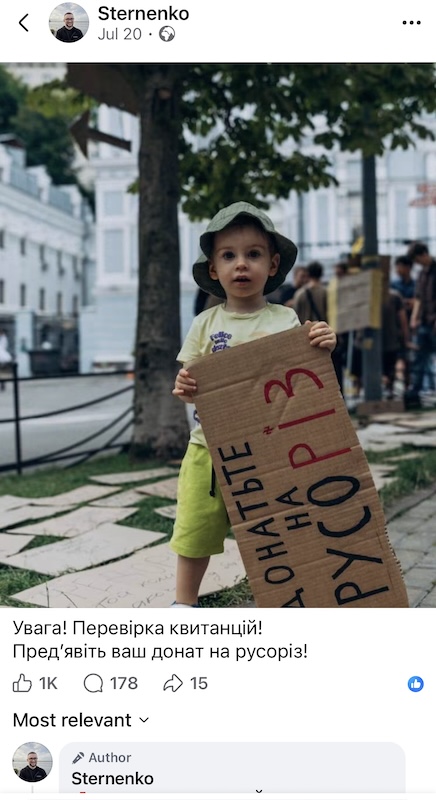
“Attention! Receipt inspection. Present your donation receipt for RUSORIZ.” — Literal translation of the caption in the screenshot of the Facebook post above.
Moreover, the money is collected through Monobank, one of Ukraine’s largest banks, using the bank’s official fundraising platform, leaving a permanent digital footprint with the transaction description “RUSORIZ.” As a result, future generations, historians, and investigators of international criminal courts may be able to examine these digital records and verify that donations were made under the transaction description “RUSORIZ”, literally meaning “to cut” or “slaughter ethnic Russians.”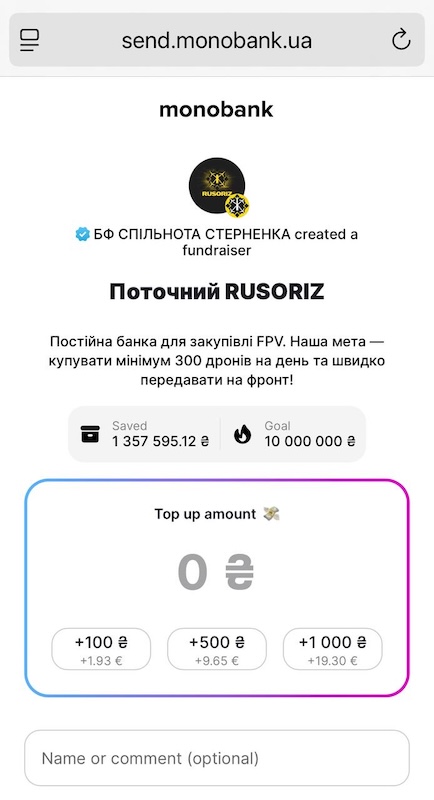
Although the fundraiser’s description states that the money is intended to purchase 300 drones, few people read the detailed description when they encounter the campaign on social media. Before opening the donation page, they see only the slogan itself, which can be interpreted without that additional context. This dual interpretation is what the entire incitement of interethnic hatred is built upon. People understand it in one context, while legally, historically, and documentarily it leaves a record of radical nationalism, with people being used blindly, and of a struggle against Russian culture and identity rather than against the Russian state.
Moreover, on his Telegram channel, which has more than 896,000 subscribers, a tactical knife is displayed under the title “Holy Rusoriz.” This shifts the focus away from drones and toward the literal image of knife violence. The knife is presented as the prize in a giveaway: anyone who donates 300 hryvnias has a chance to win the so-called “Holy Rusoriz.” This makes it difficult to interpret the campaign as being solely about drones, since the promotional image itself centers on a knife associated with the term “Holy Rusoriz.”
Additionally, on his Telegram channel, which has more than 896,000 subscribers, a tactical knife engraved with the words “Holy Rusoriz” is promoted as the prize in a giveaway. Participants who donate at least 300 hryvnias to the fundraising campaign have a chance to win it. The use of a knife as the central symbol shifts the imagery away from drones toward literal knife violence, as a knife is inherently associated with cutting human flesh. 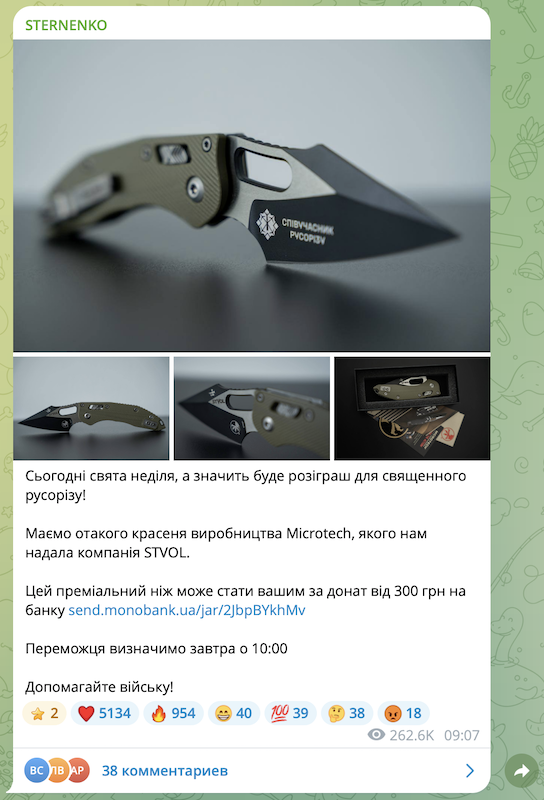
Today is Holy Sunday, which means there will be a giveaway for the “Holy Rusoriz”!
We have this beauty made by Microtech, provided to us by STVOL.
This premium knife can become yours for a donation of 300 UAH or more to the Monobank fundraising jar: send.monobank.ua/jar/2JbpBYkhMv
The winner will be selected tomorrow at 10:00.
Support the military! Link to the post
The very fact that fundraising campaigns using slogans such as “Rusoriz,” or “For killing Rusnya,” (in other campains) and similar expressions are processed through the country’s largest bank and are apparently approved by financial compliance systems, including those of the central bank as well as the Visa and Mastercard payment networks, is difficult to explain. It remains unclear how such campaigns are able to pass financial compliance and regulatory review, given the nature of the slogans.
Returning to Mykhailo Fedorov, the reason for such demonstrative public support for him among most Ukrainians remains unknown, since throughout his entire career in the government he has done nothing remarkable.
However, he has one distinctive feature that sets him apart from everyone else in the government - a very Russian surname.
“Fedorov” is unmistakably a Russian surname, regardless of the bearer’s personal identity.
And when the so-called protesters against Fedorov’s dismissal from the position of Minister of Defense of Ukraine take to the streets, addressing the bearer of the very Russian surname Fedorov while simultaneously calling him a “Russian Cutter,” it creates a historical picture implying that Ukrainians as a nationality, as it were, never existed.
And that allegedly one group of ethnic Russians called the ethnic Russian Fedorov a “Russian Cutter,” thereby portraying him as the killer of another group of ethnic Russians, thereby portraying the Ukrainian nationality as a radical ideology of the Russian ethnic group.
Based on the above, it can be assumed that the protest serves two purposes:
The first is to present Ukraine to the international community as a democratic regime.
The second is to create a historical and legal record regarding the legal subjecthood of ethnic Ukrainians, leaving future generations and historians with the impression that ethnic Ukrainians allegedly never existed as a distinct nationality and that the conflict was merely between one radical ideology of the Russian ethnic group and another.
And if these arguments are viewed from this perspective, everything comes together into a single coherent picture of the destruction of the Ukrainian ethnic group as a separate legal category with the right to land, sovereignty, and international protection.