Chronology of the Nullification and Displacement of Ethnic Ukrainians from Ukraine’s Legal Framework
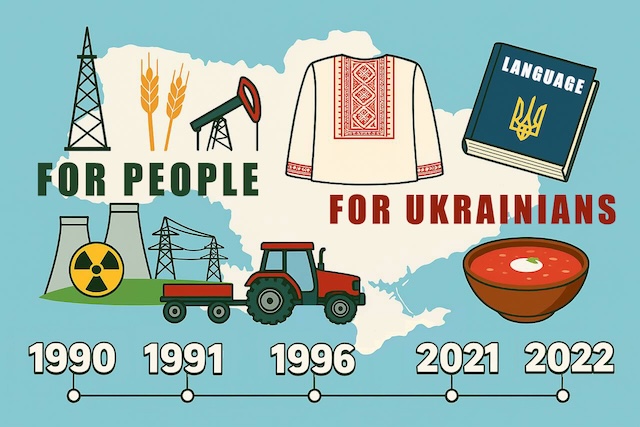
The fundamental misconception of the international community, including Ukrainians themselves, lies in the belief that cultural attributes were perceived as proof of the existence of a people. However, the right to speak the Ukrainian language is not equivalent to the status of a people in the legal sense.
For 21 years, from 1996 to 2021, Ukraine built a civic society in which the concept of “people” was interpreted universally — as the totality of citizens without ethnic distinctions.
But in 2021 the model of state organization was once again restructured — this time along ethnic lines. Certain groups received a legally enshrined status of “people” with all collective rights — to land, resources, self-government, and sovereignty. At the same time, ethnic Ukrainians were left only with language, borshch, and the vyshyvanka — cultural symbols without political subjectivity or international guarantees.
Despite the fact that the constitutional status of Ukrainians as a people was never formally abolished, a de facto substitution occurred through manipulative actions of the legislative system and subordinate regulations, including initiatives during the presidency of Volodymyr Zelensky. This led to a reinterpretation of constitutional norms without revising the actual text of the Constitution.
Thus, by 2021 a new legal construct had been created: ethnic Ukrainians were legally deprived of their already realized status as a people, and their subjectivity was reduced to decorative culture, which opened the way to assimilation and displacement from the position of the titular bearer of sovereignty.
As a result of new legislative initiatives, legal categories of collective subjectivity were created in Ukraine in which national minorities and indigenous peoples obtained recognized status, while the Ukrainian ethnic community — the majority — was reduced to the position of a population without the legal status of a people, and therefore deprived of subjectivity over power, land, territory, and sovereignty.
Below is a chronological map of the legal nullification of Ukrainians — with dates, descriptions of the changes, and explanations of the essence of each substitution.
1. 1991–1996: Ukraine as a national state, not as the citizens of Ukraine of all nationalities
During the transitional period after the proclamation of independence, the Ukrainian people were defined precisely as an ethnic and cultural subject.
On July 16, 1990, the Declaration of State Sovereignty of Ukraine explicitly stated that “the Ukrainian SSR, as a sovereign national state, develops on the basis of the Ukrainian nation exercising its inalienable right to self-determination.”
This meant that the foundation of the new statehood was tied specifically to the Ukrainian nation as the ethnic source of sovereignty, rather than to the totality of citizens of all nationalities.
June 19, 1991 – The Concept of the New Constitution of Ukraine (Resolution No. 1213-XII) stated: “The Ukrainian nation is the bearer of sovereignty and the foundation of state-building,” explicitly affirming the Ukrainian nation (in the ethnic sense) as the source of state authority.
2. June 28, 1996: The Constitution of Ukraine — the moment of legal substitution
The adoption of the Constitution of Ukraine marked a breaking point in the definition of the sovereign subject. The Preamble introduced a new formula: “the Ukrainian people are the citizens of Ukraine of all nationalities.” This construction represented a fundamental substitution. It erased the boundary between:
– the ethnic nation, which had exercised its right to self-determination in 1990–1991, and the general administrative population;
– the sovereign people as the source of independence and citizenship as an institution of belonging to the state.
Article 5 of the Constitution proclaims that “the people” are the bearer of sovereignty, but does not specify who exactly is considered this “people.” The Preamble effectively replaces the historically established ethnic subject with an undefined aggregate of citizens.
This shift had three key consequences:
-
The legal continuity between the 1990 Declaration of Sovereignty and the new Constitution was broken. While the Declaration was grounded in the act of self-determination of the Ukrainian nation, the Constitution abolished this meaning, replacing it with civic universalism.
-
A normative collision emerged: “the people” as the bearer of sovereignty in the Constitution lost its ethnic content, without which in international law it cannot be regarded as a subject of the right to self-determination.
-
Sovereignty was transferred from the titular nation — ethnic Ukrainians — to the abstract and amorphous category of “citizens of Ukraine of all nationalities.” This amounted to the legal nullification of an already realized right to self-determination, formalized in 1990.
Thus, the 1996 Constitution established not continuity but substitution: instead of the people as a historical subject, there appeared a depersonalized civic mass, which created a legal vacuum around the very foundation of Ukrainian sovereignty.
3. 2021 — Law No. 1616-IX: The Legal Definition of “People” and the Exclusion of Ukrainians
On July 1, 2021, the Law of Ukraine “On the Indigenous Peoples of Ukraine” (No. 1616-IX) was adopted. It recognized only three groups as indigenous:
– Crimean Tatars,
– Karaites,
– Krymchaks.
At the same time, the inclusion of the Karaites and Krymchaks contradicted Article 1 of this very law. According to its criteria, an indigenous people can only be one that does not have its own state formation outside Ukraine. However, the Karaites and Krymchaks possess the right to repatriation to the State of Israel and are officially recognized by Israel as part of the Jewish people. This means that they enjoy state-forming recognition beyond Ukraine. Therefore, their inclusion in the list of “indigenous peoples” represents an artificial legal construction created in direct contradiction to the letter of the law.
Yet the fundamental problem lies not even in the composition of the list. Law No. 1616-IX was the first normative act that enshrined in Ukrainian legislation a legal definition of “people” in the form of a law of direct effect.
Before 2021, the category of “people” existed only in a declarative form — in the preamble of the Constitution, which stated: “the Ukrainian people are the citizens of Ukraine of all nationalities.” This formula created the image of a civic community but remained a political declaration without the force of a direct legal mechanism.
After the adoption of Law No. 1616-IX, it was this law that effectively determined the content of the category of “people” in Ukrainian law. And that content was reduced to three ethnic groups, with no other categories of “people” recognized at all. As a result, ethnic Ukrainians, despite being the titular majority, legally remained outside this definition.
The essence of the problem does not lie in the fact that Ukrainians “were not included in the list.” The essence lies in the fact that the very adoption of Law No. 1616-IX changed the legal interpretation of the concept of “people”: from a declarative constitutional description in the preamble — to a legislative definition in which the titular nation was excluded.
This has special significance in the context of Article 5 of the Constitution of Ukraine, which establishes that “the bearer of sovereignty and the only source of power in Ukraine is the people.” However, the Constitution does not specify whether this refers to a collective subject or a sum of individual citizens. The adoption of Law No. 1616-IX created a dual interpretation: “people” can be understood as all citizens (according to the preamble), or as a limited list of ethnic groups (according to the law of direct effect). But since legislative norms take precedence over declarative provisions of the preamble, in practice it was the law that overrode the constitutional interpretation and substituted the source of authority.
4. 2022 — Law No. 2215-IX: Legal Erasure of Succession
On April 21, 2022, the Law of Ukraine “On the De-Sovietization of the Legislation of Ukraine” (No. 2215-IX) was adopted. Annex No. 2 to it repealed more than 250 normative acts of the Ukrainian SSR and the USSR, including:
– all Constitutions of the Ukrainian SSR (1919, 1929, 1937, 1978),
– acts that explicitly established that land, subsoil, property, and power belong to the working people,
– all legislative norms in which the Ukrainian people were recognized as a historical subject with collective rights.
Under the pretext of combating “Russian heritage” and neutralizing the threat of “Russian aggression,” a far more radical step was taken: the succession of ethnic Ukrainians as bearers of sovereignty was destroyed.
The repeal of Soviet and post-Soviet constitutions erased the legal foundation that linked Ukrainians to the right to land, resources, and the status of source of authority. As a result, the last legal mechanisms allowing an appeal to the succession of popular sovereignty disappeared.
Thus, Law No. 2215-IX did not so much “cleanse the legislation of Soviet legacy” as it nullified the historical subjectivity of Ukrainians within the legal system, leaving the titular majority without any reference to their own state-legal past.
5. 2022–2023 — Law No. 2827-IX: Consolidation of the Rights Asymmetry
On December 13, 2022, the Verkhovna Rada adopted the Law of Ukraine “On National Minorities (Communities) of Ukraine” (No. 2827-IX). It entered into force on July 1, 2023.
The law established a special legal status for national minorities, granting them collective rights in the spheres of culture, education, language, and self-government. Thus, ethnic Ukrainians became the only group without any recognized legal status as a collective subject and were completely excluded from the system of collective rights.
In this way, the sequence of legal steps acquired its completed form:
– in 2021 (Law No. 1616-IX) Ukrainians were excluded from the category of indigenous peoples,
– in 2022 (Law No. 2215-IX) legal continuity was abolished,
– in 2023 (Law No. 2827-IX) a special legal status was secured for minorities, while the titular majority was deliberately left outside the legal framework.
This created a final normative asymmetry: the state recognizes collective rights for everyone except ethnic Ukrainians, depriving them of legal subjectivity as a people.
6. Consequences: Erasure of a People from the Legal System
The following table summarizes the key stages in the legal downgrading of ethnic Ukrainians, tracing how their collective status was gradually dismantled through formal legislation. It shows the shift from recognized nationhood to complete exclusion from legal personhood.
| Period | Legal Status of Ukrainians |
|---|---|
| Before 1996 | Ukrainians = nation, bearer of sovereignty |
| 1996 | Ukrainians = diluted among “all nationalities” |
| 2021 | Ukrainians = not recognized as a people |
| 2022 | All supporting legal acts affirming nationhood repealed |
| 2023 |
Law No. 2827-IX: status granted to minorities → Ukrainians finally excluded from collective rights |
The last and most destructive mechanism of excluding ethnic Ukrainians from the system of succession and the status of a people was cultural and spiritual erasure. Under the slogan of fighting Kremlin influence and “Moscow priests,” the state launched large-scale persecution of the Ukrainian Orthodox Church (UOC) — the canonical successor of the Kyiv Metropolis.
Church seizures began, along with criminal cases against the clergy, pressure on monasteries and parishes. To this was added legislative interference in the calendar tradition: the celebration of Christmas on January 7 was abolished and moved to December 25, enshrined in the system of public holidays. This step destroyed the continuity of liturgical practice that had linked the titular people to the Kyiv Metropolis and a thousand years of canonical heritage.
Thus, the state is destroying not only the modern confessional structure, but also the very spiritual and legal continuity of ethnic Ukrainians. In place of the historic Church, an artificial construct was installed — the Orthodox Church of Ukraine (OCU), devoid of both historical and canonical legitimacy.
In fact, this step completed the legal disqualification of the titular people: by depriving Ukrainians of legal status, continuity, and canonical recognition, the state brought the process to its conclusion, destroying the last institution that served as legal and spiritual proof of their historical subjectivity.
7. Conclusion: Legal Nullification of Peoplehood
By 2023, a completed legal order had taken shape in Ukraine, under which ethnic Ukrainians lost all recognized forms of collective legal subjectivity (people, titular nation, historical subject) and were removed from the system of collective rights (land, resources, self-government, international protection). This is not a single decision, but a whole set of interconnected acts:
• Law No. 1616-IX (“On Indigenous Peoples of Ukraine,” 01.07.2021) — narrowed the concept of “people” to a few indigenous communities (Crimean Tatars, Karaites, Krymchaks), excluding ethnic Ukrainians. This opened a legal channel for reinterpreting Articles 5 and 13 of the Constitution in favor of specially designated collective subjects, while fully excluding the majority.
• Law No. 2215-IX (“On De-Sovietization of Ukrainian Legislation,” 21.04.2022) — retrospectively destroyed legal continuity by repealing hundreds of acts where Ukrainians were recognized as a historical people and bearer of sovereignty. In particular, the constitutions of the Ukrainian SSR were annulled, which had explicitly established that land, natural resources, property, and power belonged to the working people. Thus, the legal basis that tied Ukrainians to ownership of resources and to the status of the source of power was eliminated.
• Law No. 2827-IX (“On National Minorities (Communities) of Ukraine,” 13.12.2022 → entered into force 01.07.2023) — consolidated collective rights for minorities, definitively fixing normative asymmetry: collective mechanisms were recognized for all, except ethnic Ukrainians.
• Law No. 2834-IX (13.12.2022) — redefined the concept of “Ukrainian national identity” into cultural-ideological markers, stripping the status of “foreign Ukrainian” (No. 1582-IV, 2004) of its ethnic content. Legally, the diaspora remained a cultural category without the status of a people.
• Law No. 2235-III (“On Citizenship of Ukraine,” 18.01.2001) — left ethnic Ukrainians with the only “way back” through citizenship, not by right of origin. There is no ethnic right to repatriation.
• Additionally: the cultural-canonical block (for example, the transfer of Christmas to December 25 by Law No. 3258-IX in 2023, the campaign against the Ukrainian Orthodox Church as the canonical successor of the Kyiv Metropolia) further deepened the rupture of spiritual and legal continuity as the last evidence of historical subjectivity.
In sum, this means:
-
Exclusion from all forms of subjectivity. Ethnic Ukrainians are the only group without:
– recognized status as a people (No. 1616-IX),
– legal continuity (No. 2215-IX),
– collective rights within the system of national minorities (No. 2827-IX),
– an ethnic right of return (unlike the models of Germany, Poland, Hungary, Israel; within Ukraine only through citizenship under No. 2235-III),
– diaspora-based confirmation of ethnicity (after redefinition of identity by No. 2834-IX and effective nullification of No. 1582-IV).
-
Substitution of the people with culture. Language, symbols, and folklore were offered instead of the status of a sovereign people. This turned subjectivity into an object of interpretation, not a legal right.
-
Constitutional paradox. While Articles 5 and 13 of the Constitution call the “people” the bearer of sovereignty and the owner of resources, after 2021–2023 this concept was filled with narrow categories, from which Ukrainians as an ethnic group are absent. The majority has no functioning institutions for exercising the right to self-determination, land, resources, and protection.
-
Closure of external and internal channels of restoration.
– Inside: exclusion from “the people” + destruction of continuity + no law on the titular nation → no legal addressee through which to restore collective rights.
– Outside: the “foreign Ukrainian” has been shifted into a cultural, not ethnic, plane (No. 2834-IX), ethnic repatriation is not provided — meaning there is no inalienable link by origin.
Conclusion. The set of norms No. 1616-IX → No. 2215-IX → No. 2827-IX (together with No. 2834-IX, No. 2235-III, amendments to No. 1582-IV, and cultural-canonical revisions) created a closed system:
• the “people” as a collective subject was transferred into special categories,
• ethnic Ukrainians were excluded from them,
• legal continuity was eliminated together with the principle of ownership by the working people,
• ethno-repatriation and diaspora mechanisms were neutralized,
• spiritual and cultural continuity was severed.
Thus, in the current legal system there exists no trajectory by which ethnic Ukrainians could realize their right to self-determination and other collective rights.