What is Voice of Ukrainians Project?
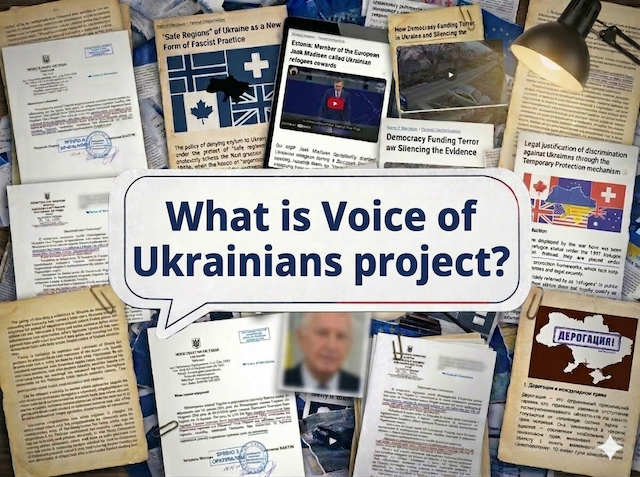
The Voice of Ukrainians project is an act of national resistance through legal means, as well as a public statement about crimes and a cry for help on behalf of the Ukrainian people, who were legally eliminated and completely replaced by other national groups in the context of the Ukrainian–Russian conflict, which served as an ideal cover for such legislative transformation.
Initially, the project was created as a database for the documentation of discriminatory statements, publications, and cases of public harassment against Ukrainian citizens in European politics and media, in order to collect such facts in one place, to record the systemic nature of the campaign of discrimination and discreditation, to demonstrate that the matter does not concern isolated episodes but rather a general trend and an established socio-political and media narrative, and, where necessary, to use legal mechanisms for juridical response.
However, in the course of the work, the analysis of legislation, international law, and political decisions, the project gradually moved beyond the framework of reacting to individual discriminatory statements and was transformed into a broader documentary investigation of processes evidencing the fact of intrusion into and seizure of the Ukrainian state by two aggressor states simultaneously, which in effect has given this work the character of a legal investigation and a public form of collective self-determination.
Ukraine is the only country in Europe where land, subsoil, natural resources, and even atmospheric air are legally owned by the people (people as a collective legal subject, not as individual persons) and not by the state. This distinguishes it from most post-Soviet countries, including Russia, Belarus, the Baltic states, and the countries of the Caucasus, where such resources are legally vested in the state, while a comparable model exists only in Kazakhstan. In most countries of Western Europe and in the United States, the concept of the people has primarily a political meaning and is not connected with the institution of collective ownership of territory and natural resources.
The economic system there was formed over centuries under conditions of capitalism, therefore land, resources and productive assets are in either state or private ownership, and in some monarchies formally belong to the Crown. The term “people” itself is used mainly as a source of legitimacy of power, but not as a bearer of collective property rights, since the very idea of collective ownership of land and natural resources by the people is a product of the Soviet legal system and its economic model.
In Ukraine, the situation is different, because the Constitution assigns to the people not only political sovereignty but also collective ownership rights over land, natural resources, and the territory of the country. As a result, the concept of the people functions not only as a political category but also as a legal title of ownership.
This legal construction is reinforced by Ukraine’s historical and economic context. After more than seventy years of a state-controlled economy during the Soviet period - land, natural resources, and industrial assets remained outside private ownership. And for nearly thirty years after gaining independence, agricultural land — which constitutes one of the largest resource bases in Europe — remained under a moratorium on sale, while thousands of enterprises remained in state ownership.
As a result, the collective ownership framework associated with the “people” in Ukraine covers an incomparably larger share of national resources than in most Western economies that have undergone centuries of capitalist privatization.
Under such legal conditions, the conquest and takeover of a state may be carried out not only through military action, but also through a legal subversion aimed at altering the constitutional composition of the people, to whom, by virtue of constitutional norms, the territory, its resources, and the authority exercised over it belong.
As it turned out, direct military action is extremely ineffective compared to the phenomenally effective legal mechanisms of invasion, occupation and acquisition of legal title to territory, but it nevertheless performs its role by diverting public attention, dulling vigilance and, under the pretext of martial law, effectively blocking criticism from lawyers and human rights advocates. As a result, regardless of motives or intentions, this objectively creates cover for a more effective invasion, occupation and acquisition of legal title to territory by a foreign aggressor state.
In any country, a person usually has three legal statuses simultaneously: that of an individual, a citizen of the state, and a member of the people as a collective subject. The concepts of “people” and “nation” may be used either to denote an ethnocultural community or a civic community, and both meanings are valid. However, the law must clearly define in which specific sense the term is being used, since legal uncertainty and double interpretation are prohibited by both national and international law.
The specific feature of the linguistic structure of the Ukrainian and Russian languages is that liudi (“люди” — individual persons) and narod (“народ” — a collective people) have different meanings, whereas in English such a distinction is impossible, since both meanings are conveyed by the single word people. Without such clarification for an English-speaking audience, the text may be mistakenly perceived as denying the status of a human being, whereas in fact it concerns only the distinction between people (liudi) as individual persons and people (narod) as a collective legal category.
If the legal system preserves the status of the individual and the citizen but lacks legal recognition of belonging to the people, while at the same time the people are declared the source of power and the collective owner of land and natural resources - а situation arises in which a citizen effectively turns into a foreigner on their own land, since the status of a natural person and a citizen in itself, without recognition of belonging to a people, does not legally differ in any way.
In such a construction, the population formally remains citizens but loses the status of bearers of sovereignty, the source of power, and the collective owners of land and resources, while their belonging to the people is not established by law and turns into a matter of political interpretation and a kind of religion, under which citizens can be declared the people when they are required to pay taxes and defend the territory, and their belonging to the people can be denied when the issue concerns the right to land, natural resources, national wealth, and power.
Both de jure and de facto this is a colonial-feudal model of governance that emerged as a result of manipulations with the constitutional norms of the Ukrainian state, but formally preserving a republican form of government, under which power and national wealth belong exclusively to legally recognised ethnic groups, and all citizens are effectively transferred into the position of subjects, upon whom, by administrative order, it is possible to implement a system of carbon footprint, digital currencies, compulsory vaccination, forced relocation to ghettos, force assimilation into another ethnic group or state, or complete expulsion and deprivation of citizenship.
And all of this without any right to rebellion.
This is conditioned by the fact that, within the constitutional order, Article 13 of the Constitution determines that the right of ownership to land, subsoil, natural resources and even atmospheric air is the right of ownership of the Ukrainian people, whereas the right of use is granted to citizens of Ukraine in the manner prescribed by law. However, neither the Constitution itself nor Article 13 of the Constitution contains any requirement or provision regarding the free-of-charge nature of such use — therefore, at the legislative level and entirely legally, citizens may be obliged to pay for such use, where the beneficiary of such payment will be precisely the owner, that is, the one recognized as the Ukrainian people, and not merely a citizen.
Chronology of the legal substitution of the composition of the Ukrainian people:
The Constitution of Ukraine consists of the Preamble and the articles of the Constitution, where the Preamble is an introductory, that is, opening part, which is located before the articles and sections of the Constitution and performs the role of a kind of preface, has a founding and declarative character and has legal significance as a part of the Constitution, since it establishes by whom exactly the Constitution is adopted and on which principles it is based, however its provisions do not contain norms of direct legal effect, whereas the articles of the Constitution are norms of direct legal effect, establish specific rights and obligations, are subject to direct application and provide for legal consequences in case of their non-fulfilment.
For reference, a declaration - is a document of a declaratory nature that sets out principles, intentions, and general orientations, but is not a law or legal act containing norms of direct effect; therefore, by itself it does not establish binding legal obligations and does not provide mechanisms of liability for its non-performance. At the same time, it may have important historical, constitutive, and interpretative significance, serve as a guideline for legislation and legal practice, and be used as a reference in the interpretation of legal norms.
The process of constituent devaluation of the significance of the preamble of the Constitution began with the adoption of Law of Ukraine No. 2680-VIII of 7 February 2019 on amendments to the Constitution, when a formula on the irreversible course toward membership in the EU and NATO was added to its text. However, such a formulation by itself does not make Ukraine a member of the European Union or the North Atlantic Alliance (NATO) and does not create for these organizations any obligations to admit Ukraine.
By its nature, such amendments introduce a political and ideological component into the text of the Constitution rather than a provision of a founding character, thereby violating the fundamental principle of the 1990 Declaration of State Sovereignty of Ukraine, where Section IX explicitly states that Ukraine solemnly proclaims its intention to become, in the future, a permanently neutral state that does not participate in military blocs.
This, in turn, began to be regarded by the Russian Federation as a threat to the previously proclaimed principle of Ukraine’s neutral status, diminished the founding significance of the relevant provisions, and effectively created for Russia a formal pretext to use this as justification for its claims regarding the violation of previously declared principles of the constitutional order of Ukraine, which creates the impression of deliberate intent behind such actions.
Moreover, the Constitution of Ukraine itself does not even provide a procedure for introducing amendments to its preamble, since it has a founding character and establishes the original grounds for the adoption of the Constitution, whereas the Constitution itself establishes a procedure specifically for introducing amendments to the articles of the Constitution, but not to its preamble.
It should be noted that the preamble of the Constitution has never in itself contained a rule of law. It is an integral part of the Basic Law that serves as a guiding element and expresses the fundamental principles of the state system, its goals and ideals, but does not create binding obligations for subjects of law. The legal force of the preamble has always been debated among lawyers: some have considered it purely declarative, while others have treated it as a source of guidance for interpreting the Constitution.
Even the existing decisions of the Constitutional Court of Ukraine in which the formula from the preamble referring to the “Ukrainian people — citizens of Ukraine of all nationalities” was mentioned in one way or another generally only referred to it — sometimes quoting it directly, sometimes simply reproducing its meaning — but did not create on its basis either an independent rule of law or any new legal obligation.
When such decisions stated (№ 1-р/2021) that “the concept used in the preamble of the Constitution of Ukraine, ‘the Ukrainian people — citizens of Ukraine of all nationalities,’ covers all individuals who have Ukrainian citizenship,” this in fact only repeated the literal meaning of the preamble itself, where it is directly stated that the Constitution is adopted “on behalf of the Ukrainian people — citizens of Ukraine of all nationalities.” The Constitutional Court does not create norms of law and does not determine the composition of the people, but only clarifies the already existing text, and such clarification is binding for application.
In this case, it did not establish any new criteria and did not give this formulation the character of a norm of law, but only confirmed the obvious meaning of what is written — approximately the same as explaining that 10 centimeters equal 100 millimeters or that a day consists of day and night. Moreover, interpretation of a non-normative text remains non-normative — binding as interpretation, but not producing a norm of direct effect.
Thus, even prior to the adoption of the Law of Ukraine No. 3354-IX of 24 August 2023 “On Law-Making Activity”, the preamble of the Constitution had in practice been gradually and procedurally weakened and devalued in terms of its normative legal and founding significance, including the formula concerning the Ukrainian People — citizens of Ukraine of all nationalities, which overall weakened its significance as a provision defining the composition of the Ukrainian People.
In 2021, the Law of Ukraine No. 1616-IX “On the Indigenous Peoples of Ukraine” was adopted.
And the legal claim is that Law No. 1616-IX is the only law in Ukrainian legislation in which specific nationalities are directly and legislatively recognized precisely as a people. At the same time, already in Article 1 of this law there are two mutually exclusive contradictions.
First, the wording about peoples “formed on the territory of Ukraine” is applied to Karaites, Krymchaks and Crimean Tatars, although these groups were formed on the territory of the Crimean Peninsula long before the emergence of Ukraine as a state and as a political and legal jurisdiction, which makes the application of such a criterion impossible.
Second, the very criterion for defining an indigenous people, established in Article 1 of this law, requires the absence of its own state formation outside Ukraine, whereas Karaites and Krymchaks are considered not as separate isolated groups, but as part of the Jewish people precisely in the ethnic, not the civic sense. That is, they are included in it as Jews, not as citizens of the State of Israel, which has its own state in the form of Israel, which means that the corresponding state-forming entity for these communities already exists. Therefre, their recognition does not meet the criteria of Law No. 1616 itself.
However, the most destructive and shocking aspect of this legal situation is that neither the Constitution of Ukraine, nor its articles, nor any law of Ukraine, nor any article of any law of Ukraine contains an established norm — that is, a norm of direct effect — that explicitly establishes the legal formula “citizen of Ukraine = People.”
From 1996 to 2021 this had no practical significance, because no national or cultural group was singled out by law as a separate people and no one possessed such a status. Therefore the declarative formulas in the Preamble of the Constitution and in the Declaration of State Sovereignty stating that the Ukrainian people consist of citizens of Ukraine of all nationalities effectively performed their function and were perceived as a description of a single civic composition of the people, and no competition arose over this concept itself. Ukrainian nationality as a separate category is not mentioned even once in the Constitution of Ukraine.
It should be clarified that the reference to the “Ukrainian nation” in Article 11 of the Constitution, although it may be perceived in an ethnocultural sense, since the same provision separately mentions indigenous peoples and national minorities - does not eliminate legal uncertainty and allows for double interpretation, because in the same 1996 version of the Constitution its Preamble establishes a civic understanding of the nation by defining the Ukrainian people as citizens of Ukraine of all nationalities. At the same time, the formula of Article 11, “The State promotes the consolidation and development of the Ukrainian nation…,” does not define the composition of the people as a legally determined subject, does not establish criteria of belonging to it, and does not produce legal consequences in terms of the distribution of the source of power or collective ownership, since by its nature it is programmatic (declarative), without binding obligations or guarantees, and expresses a direction of state policy rather than a rule subject to direct application. Such “promotion by the state” may even be limited to a purely formal expression of “concern.”
This can be compared to a house that is not formally registered to a specific owner: as long as no one asserts a separate legal claim to it, the people living in it calmly consider it theirs. But as soon as the law begins to designate particular “owners,” the situation changes, because it then becomes clear who actually holds the right and who merely lives there.
From that moment on, in any court proceedings concerning collective rights to land, resources, territory, or the right to power, the court will inevitably side with those who are explicitly named in the laws and the Constitution of Ukraine as a people rather than as citizens, since the legislation contains no rule of law that directly establishes that citizens are legally equal to the people — not in the form of a declaration, but as a rule of law of direct legal effect.
Then Law No. 2215-IX “On the De-Sovietization of the Legislation of Ukraine” (2022) was adopted, which declared a significant part of Soviet laws and decisions of the authorities of the USSR and the Ukrainian SSR inapplicable. Since those laws had previously explained the origin of the people’s collective rights to land, natural resources and state authority, as well as the legal continuity of modern Ukraine with the Ukrainian SSR, their repeal effectively broke the legal line of inheritance linking those rights to the generations that constituted the people before 1991. As a result, the collective rights formally remained in the constitutional system of Ukraine, but the legal basis allowing the descendants of that earlier people to claim them as their inherited rights was removed.
Also, in 2022, the Law of Ukraine No. 2827-IX “On National Minorities (Communities) of Ukraine” was adopted.In this law, national minorities are not once referred to as a people or as part of the people; instead, they are defined only as ethnocultural communities.
But as long as the legal significance of the Constitution’s preamble had not been legislatively devalued, representatives of national minorities could still consider themselves part of the Ukrainian people by referring to the formula in the preamble about the “Ukrainian people — citizens of Ukraine of all nationalities.”
Additionally, in 2022 a systematic persecution of the Ukrainian Orthodox Church (UOC) began — the canonical successor of the Kyiv Metropolis, an ancient church structure that has existed on these lands since the Christianization of Rus in 988. Under the pretext of combating “Moscow influence,” the institution through which the canonical and historical continuity of the Ukrainian people with the churches, lands, and spiritual heritage of this territory had been preserved was effectively and legally dismantled.
Thus, the last institution through which the Ukrainian people could refer to their canonical and historical continuity on their own land was eliminated. The structure created by the state on December 15, 2018 — the Orthodox Church of Ukraine (OCU/PCU) — presented as an instrument of canonical independence from Russia, does not possess such continuity and therefore cannot serve as confirmation of the uninterrupted connection of the people with this territory. It may perform ordinary religious functions of worship, however it is not the institutional successor of the Kyiv Metropolis and does not preserve the line of succession that previously existed.
Explanation of abbreviations:
UOC (Ukrainian Orthodox Church) — a historical Orthodox church structure that traces its canonical succession to the Kyiv Metropolis.
OCU/PCU (Orthodox Church of Ukraine) — a church structure established in 2018 and granted a Tomos of autocephaly in 2019 by the Ecumenical Patriarchate.
The final mechanism of devaluing and dismantling this continuity was the legislative transfer in 2023 of the celebration of Christmas from January 7 to December 25. Considering that around 80% of Ukrainians traditionally celebrate Christmas according to the Julian calendar, this decision effectively undermined the authority of the canonical tradition associated with the Ukrainian Orthodox Church and the religious practice of the Ukrainian people.
Many still do not realize that the persecution of this church has little to do with combating “Russian influence,” but in practice amounts to the elimination of canonical continuity so that in the future it cannot be invoked as evidence of the historical connection of the Ukrainian people to this territory.
After that, the Law of Ukraine No. 3354-IX of August 24, 2023, “On Lawmaking Activity,” was adopted. Article 38, paragraph 2 of this law establishes the rule that the preamble of a law -does not contain norms of law.
Only draft laws introducing amendments to the Constitution of Ukraine are explicitly excluded from the scope of this law, that is, the procedure for constitutional amendments itself. However, Law No. 3354-IX is not such a draft law aimed at amending the Constitution; it merely introduces a general rule of legal application for the preambles of all laws on the territory of Ukraine. At the same time, the provision defining the preamble as a non-normative part of a law is not accompanied by a separate clause stating its inapplicability to the preamble of the Constitution as the Basic Law, which by its nature, although fundamental, is still a law and even has its own number: No. 254к/96-ВР.
This allows the conclusion that the formula in the Preamble of the Constitution of Ukraine referring to the “Ukrainian people — citizens of Ukraine of all nationalities” does not in itself establish the legal composition of the people if such a norm is not reproduced in the articles of the Constitution of Ukraine or in the articles of any law of Ukraine containing a norm of direct effect, unlike the Preamble, which was declarative from the outset and, after the adoption of Law No. 3354-IX “On Law-Making Activity,” was effectively removed from the sphere of legal norms.
Evidence of intent and targeted encroachment on the preamble of the Constitution may lie in the very structure of Law of Ukraine No. 3354-IX. In accordance with paragraph 1 of Section XIV “Final Provisions” of this Law, it enters into force on the day following the day of its official publication, but is put into effect only one year after the termination or cancellation of martial law in Ukraine. The list of exceptions specified in this paragraph does not include Article 38 of this Law; therefore, it falls under the general rule governing entry into force and implementation.
This creates a situation in which the provision of Article 38 of this Law stating that the preamble of a law does not contain legal norms may be invoked while avoiding its full legal application. This also indicates its direct orientation toward the preamble of the Constitution and the formula stating that the Constitution was adopted “on behalf of the Ukrainian people — citizens of Ukraine of all nationalities,” effectively creating a mechanism for its legal devaluation in circumvention of Article 157 of the Constitution of Ukraine, which prohibits amendments to the Basic Law during the period of martial law.
After this, the Law of Ukraine No. 4700-IX “On the Status of the Founder of the Modern State of Ukraine — Member of Parliament” (2025) is adopted, which establishes that modern Ukrainian statehood was founded through the votes of specific deputies of the Verkhovna Rada, rather than directly by the Ukrainian people.
If the formula of the Ukrainian people as citizens of Ukraine of all nationalities in the preamble is not legally operative, and the act of creating the state is linked to the vote of parliament, then the role of the founder of statehood shifts from the people to the Verkhovna Rada.
This constitutes a legal substitution of the founders of the Ukrainian state.
After the adoption of Law No. 1616 on Indigenous Peoples, it became apparent that the formula in the preamble of the Constitution — “the Ukrainian people, citizens of Ukraine of all nationalities” — as a universal definition of the composition of the people began to conflict with the existing legislation. The Law of Ukraine on Indigenous Peoples does not establish a requirement of Ukrainian citizenship for belonging to an indigenous people and effectively recognizes their global diasporas as indigenous peoples regardless of their citizenship.
In this context, the provision of Article 38, paragraph 2 of the Law of Ukraine No. 3354-IX “On Law-Making Activity”, according to which a preamble does not contain legal norms, essentially became a forced measure to balance the emerging contradiction. On the one hand, it made it possible to remove the formula of the constitutional preamble from the sphere of normative determination of the composition of the people. On the other hand, it simultaneously became a mechanism for the effective replacement of the previous construction of the composition of the people, since the only collectives explicitly recognized by the laws of Ukraine as peoples remained the indigenous peoples, while other groups possess only the status of communities, citizens, or natural persons.
Since the current composition of the Ukrainian people includes groups that did not legally exist in such a status at the time of the proclamation of independence, it becomes impossible to claim that the Ukrainian people themselves are the founders of Ukrainian statehood. The groups that were considered part of the people at the time the state was founded have effectively been removed from this construction, while those included in it today did not legally exist in that capacity at that time. Therefore, in order to eliminate this contradiction and avoid possible legal disputes and claims in the future, they were forced to link the foundation of Ukrainian statehood not to the people, but to the members of parliament who voted for independence.
Thus, all citizens of Ukraine have been removed from the composition of the Ukrainian people and from the category of founders of the Ukrainian state. Consequently, the provisions of Article 13 of the Constitution concerning the ownership rights of the Ukrainian people to land, subsoil, and natural resources no longer apply to them, just as the provisions of Article 5 of the Constitution — which defines the people, not citizens, as the sole source of power and the bearer of sovereignty in the state — also cease to apply.
An additional problem is that international law primarily protects peoples as collective holders of sovereignty, whereas the status of a citizen exists only within the jurisdiction of a state. It is peoples who possess the right to self-determination, territory, land, and natural resources, as established in the Charter of the United Nations and in Article 1 of the International Covenant on Civil and Political Rights and the International Covenant on Economic, Social and Cultural Rights.
If the citizens of Ukraine are legally removed from the category of a people and exist only as individual citizens and natural persons, then their forced assimilation can no longer be regarded as the suppression or oppression of a sovereign people. In such a situation, actions in the occupied territories may be interpreted not as a crime against a people, but as a struggle against particular groups or ideologies — which effectively coincides with the Russian narrative of “denazification.”
And the status of an oppressed people and a victim of aggression and occupation, entitled to international compensation and reparations through international judicial mechanisms and sanctions procedures, has been institutionally and in advance removed from the citizens of Ukraine as a whole and assigned only to those groups that are legally recognized as a people. The fiction lies in the fact that in public and political discourse the formula “the Ukrainian people” will be perceived as referring to all citizens; however, in a legal sense it will mean only those groups that, at the moment of occupation, colonization, or subjugation, were legally included in the composition of the people in Ukrainian law.
As a result, a structure is formed in which, in the event of occupation, only ethnocultural groups recognized as indigenous peoples may act as legally recognized victims of aggression and claim compensation and reparations, and in the event of the liberation of territory — as a collective subject possessing the legal title of a people and, consequently, the associated rights of ownership and sovereignty over the territory.
The problem is that the indigenous peoples recognized in Ukraine have a dual identity: the Karaites and Krymchaks are internationally regarded as part of the Jewish people and generally reside in Israel, while in Ukrainian legislation they are designated as separate indigenous peoples without numerical limits and without a mandatory requirement of citizenship.
Moreover, in the Karaite religious tradition, the conduct of a census is prohibited, which precludes any objective determination of their numerical size. In the absence of statutory limitations or verifiable legal criteria in Law No. 1616 - this effectively establishes an unlimited legal mechanism under which affiliation with this category is not subject to verification and its numerical scope cannot be objectively determined or legally constrained. As such self-identification is protected by the freedom of religion (Article 35 of the Constitution of Ukraine), it is effectively immune from legal challenge, thereby enabling the declaration of any numerical size without the possibility of legal contestation.
And Crimean Tatars are formally recognized as an indigenous people, however the mechanisms of realization of their collective rights are factually and legally blocked due to the situation around Crimea, recognition of the Mejlis by the Russian side as an extremist organization and absence of ratification by Ukraine of ILO Convention No. 169, which provides international guarantees of protection of the rights of indigenous peoples.
ILO Convention No. 169 is the only international convention specially devoted to protection of the rights of indigenous peoples. In Europe it was ratified, in particular, by Norway, Denmark, the Netherlands, Spain, Luxembourg and Germany, which emphasizes its significance as the main international legal instrument of ensuring collective rights of indigenous peoples.
In contrast to this, Karaites and Krymchaks, as groups belonging to the Jewish people, fall under international mechanisms of protection of Jewish communities, norms of counteraction to antisemitism, protection of freedom of religion and non-discrimination, monitoring from international organizations, diplomatic reaction of the State of Israel, as well as institutional support of global Jewish organizations, which factually creates for them a system of international guarantees even without ratification of ILO Convention No. 169.
However the factor of Turkey was not taken into account, since Law No. 1616-IX recognizes indigenous peoples without limitations regarding citizenship of Ukraine and permanent residence, its effect automatically extends to the entire global diaspora, and exactly in the case of Crimean Tatars this creates a direct legal loophole, since the largest part of this people resides in Turkey.
Accordingly, should Turkey grant political subjectivity to Crimean Tatars within its jurisdiction, a formal legal mechanism arises for the assertion of legal, territorial, and proprietary claims on behalf of a people already recognized by the law of Ukraine as an indigenous people of Ukraine, thereby potentially enabling claims to authority, territory, and natural resources across the entire territory of Ukraine as the collective property of the people, or alternatively transforming this legal status into an instrument of large-scale geopolitical bargaining over sovereignty, territory, and state resources.
Legally, this means the institutionalized facilitation and transfer of Ukraine’s sovereignty to two foreign aggressor states in a legal form. By excluding the citizens of Ukraine from the category of the people, Ukrainian legislation removes the collective legal category through which international law qualifies forced assimilation, colonization, enslavement, and genocide as crimes against a people, thereby granting Russia legal immunity and an effective indulgence. At the same time, the monopolistic recognition as indigenous peoples of groups that internationally are regarded as part of the Jewish people and generally reside in Israel effectively transfers to them the collective title of the Ukrainian people — and thus the status of the bearer of sovereignty and the collective owner of the land, resources, and territory of the state.
When, in the occupied territories, the propaganda slogan “We are one people” is systematically and widely displayed on street billboards, reflecting the state narrative of the Russian Federation that denies the existence of Ukrainians as a separate nation and asserts a claim to include this population as part of the Russian people, while Ukrainian legislation simultaneously deprives this population of the legal status of the Ukrainian people — the legal system of Ukraine effectively facilitates its unpunished inclusion into Russian jurisdiction and indicates the coordinated nature of the legal and political processes and their consequences.
The situation is aggravated by the use of the temporary protection mechanism instead of full refugee status under the Geneva Convention for Ukrainian citizens in the EU, the United Kingdom, the United States, Canada and other countries, which provides a collective form of status without the individual collection of written testimonies and without recording the ethnic identity of applicants, thereby effectively turning this mechanism into an instrument for removing millions of witnesses from procedures documenting the circumstances of possible international crimes and at the same time into a means of concealing their national identity, enabling their forced assimilation into the composition of Russia in the future without the risk of any legal liability.
In effect, this constitutes a legal loophole enabling the arbitrary expansion of the “composition of the people” by external actors without any effective legal safeguards, constraints, or possibility of judicial challenge.
Expanded social guarantees, and personal freedoms: the right to work, the right to reside outside camps, freedom of movement, the ability to travel abroad, the possibility to visit one’s own country without losing status, as well as the retention and use of a national passport for travel — within the framework of the temporary protection mechanism are in practice granted at the cost of renouncing the possibility of recording one’s ethnic identity and the right to provide written testimonies, which constitute a key element of the procedure for obtaining full refugee status under the 1951 Geneva Convention Relating to the Status of Refugees.
Within the framework of the presented legal construction, the reference to hostilities as the reason for the non-holding of elections effectively functions as a screen, since the real reason lies in the loss by citizens of the right to vote and to be elected.
If citizens of Ukraine are removed from the composition of the people, they lose the right to vote and to be elected, since according to Article 38 of the Constitution it is citizens who vote, but they do so on behalf of the people, to whom power belongs under Article 5. Therefore, in this situation the holding of elections becomes legally impossible: citizens have been removed from the composition of the people, while the groups recognized as peoples have either not yet acquired citizenship and electoral rights, or are literally blocked on the territory of the Crimean Peninsula, as a result of which in Ukraine de jure there is no subject capable of exercising power and realizing it through the electoral process.
In such a situation, there cannot exist a constitutional duty of citizens to defend the Fatherland to which they no longer legally belong. Article 65 of the Constitution of Ukraine explicitly refers to the defense of the Fatherland, not the state, and imposes this duty on citizens. However, the very concept of the Fatherland, precisely as used in the Constitution rather than the term “state,” presupposes a legal connection of the citizen specifically with the people, since under Article 17 of the Constitution of Ukraine the defense of sovereignty and territorial integrity is the matter of the entire Ukrainian people, not citizens. If citizens are legally removed from the composition of the people, then the Fatherland becomes alien to them, and mobilization loses its constitutional basis and turns into mercenarism and violent coercion into service to a foreign sovereign, which legally reproduces a colonial model of coercing the population to serve not their own people.
And the liquidation of the cultural identity of ethnic Ukrainians was achieved by transforming the Ukrainian language from a marker of ethnic identity into a formal attribute of belonging to state jurisdiction. Its total and coercive imposition on all groups of the population, including national minorities, under the threat of accusations of “working for the aggressor,” produced a paradoxical effect in which the language ceased to function as a marker of the cultural identity of ethnic Ukrainians as a distinct people and instead became a sign of belonging to the state, thereby destroying one of the last visible indications of the existence of Ukrainians as a national group.
Most likely, for the same reason, throughout nearly thirty years of Ukrainian independence the Russian language did not receive the status of a state language, since in such a case the Ukrainian language would have remained exclusively the language of the Ukrainian nationality and would have continued to serve as a clear marker of the cultural existence of Ukrainians as a distinct nationality.
It was precisely through the language factor that the most severe forms of coercion and repressive arbitrariness were implemented by the state apparatus — including the police, the Security Service (SBU), and the Territorial Recruitment and Social Support Centers (TCC) — encompassing violence, abductions, beatings, killings, forced detentions, the suppression of religious communities, the closure of borders, the persecution of individuals attempting to evacuate from active combat zones, and other forms of state terror. As a result, in public perception the Ukrainian language itself increasingly becomes associated exclusively with violence, lawlessness, and arbitrariness, despite the fact that these actions are not carried out by ethnic Ukrainians as such, but by the multinational personnel structure of the state apparatus, composed of representatives of various nationalities acting within a unified institutional system.
As a result, an internal public demand emerges for the cessation of this violence; however, since this entire experience becomes directly associated with the Ukrainian language, the language itself begins to be perceived as the symbol of the problem, and this internal demand paradoxically converges with the Russian thesis of “denazification,” in which “Nazism” is effectively reinterpreted to mean the Ukrainian language itself.
Thus, “liberation” comes to signify the abandonment of the Ukrainian language — that is, forced Russification — and, in the absence of a clearly established legal status of Ukrainian nationality, this leads to the ultimate eradication even of the formal markers of its existence and eliminates the possibility of subsequently demonstrating its existence as a distinct ethnic community.
When millions of video recordings documenting episodes of violence and arbitrariness by state structures — which are currently subject to strict censorship within the Western information space — eventually become widely accessible, this will trigger a reaction comparable to the delayed public shock that followed the exposure of the crimes of Nazi Germany, when the position “we did not know” emerged; in such a context, responsibility for the actions of state institutions is likely to be transferred onto Ukrainian identity itself, fostering a readiness to justify sweeping restrictions against Ukrainians and to regard their forced assimilation as the purportedly necessary means of bringing an end to the violence with which they are being associated.
Since Ukraine has institutionally eliminated both the legal and the cultural identity of the Ukrainian nationality, this once again creates a situation of assistance to the Russian Federation as the aggressor state. As a result, it becomes possible to deny the very existence of the Ukrainian nationality and to sustain the narrative of a struggle not against a people, but merely against a “Nazi ideology.”
It could be cited as an example Norway and Sweden that the recognition of indigenous peoples in itself does not lead to the exclusion of the majority, however such a comparison is incorrect. These are constitutional monarchies where key resources and collective ownership are legally assigned to the state, not to the people, with one stable national identity, without internal competition for the status of the people and without external denial, therefore the question “who is the people” does not have legally determining significance. In these countries such a problem does not arise, because there is no external aggression and no legal situation in which the composition of the people becomes a subject of political or legal interpretation.
In Ukraine there is a multinational republic where the people acts as the collective owner of land and resources, therefore the question of its composition has direct legal significance, unlike constitutional monarchies where it does not determine the title of the collective owner. At the same time inside the country there is political competition between different ethnocultural groups, inter ethnic conflict and a dual linguistic environment, as well as a situation in which a neighboring state disputes the existence of the people as a separate entity and declares claims to its identity, which makes the question of who exactly is the people absolutely critical, and international law operates exactly with the category of the people, ensuring protection from genocide, forced assimilation, enslavement and colonization.
All materials presented on this website are the result of a three-year investigation (2023–2026) and contain evidence of criminal actions and omissions by all parties involved. This investigation was prepared by a representative of the Ukrainian people — a people who have been legally dispossessed, stripped of their status as the source of power and co-owners of their land and resources, effectively and legally occupied by two aggressor states, oppressed, and removed from control over their own state.
The new description of the project is formulated in such a way that, to understand the overall picture of the processes taking place, it is sufficient simply to read it, and in principle it is not necessary to read the other materials on the website, since the remaining texts are merely the path through which this understanding gradually formed.
Russian aggression and occupation are unequivocally condemned by the author of the project and are in no way supported or justified. However, this is precisely what almost everyone is talking about today, whereas the purpose of the project is to demonstrate that Russian aggression is not the only form of aggression and invasion faced by the Ukrainian people.
But since aggression as a concept is defined not only within a military context, but also as any form of encroachment on another’s property, in addition to military aggression there exists another, less obvious form of aggression, implemented through legal mechanisms, which manifests itself in the unlawful appropriation and seizure of the right to collective property and effectively leads to the legal occupation, subjugation, and colonization of the Ukrainian people, their fraudulent replacement, the theft of their identity, and the deprivation of their right to self-determination.
Solution:
The Ukraine–Russia conflict can, in principle, be halted through the adoption of only a limited number of legislative acts, without the need to amend the Constitution of Ukraine. This requires the enactment of a law on the status of the titular nation — ethnic Ukrainians — explicitly establishing that ethnic Ukrainians constitute the Ukrainian people and qualify as a people in the legal sense. Such recognition would shift the matter from the realm of a dispute over jurisdiction into the legal framework of encroachment upon a sovereign people, thereby triggering the application of international and humanitarian law mechanisms designed for the protection of peoples as subjects of law.
Simultaneously, amendments must be introduced to Law No. 2827 “On National Minorities (Communities) of Ukraine,” explicitly establishing that, beyond their classification as ethnocultural communities, these groups are also legally recognized as forming part of the Ukrainian people as a people in the collective juridical sense. Such recognition removes grounds for allegations of exclusivist nationalism and affirms a single, unified legal concept of the people as an indivisible collective subject of sovereignty, preventing any structural division into recognized and unrecognized groups and restoring the continuity of the people as a bearer of collective rights under domestic and international law.
From the perspective of states receiving Ukrainian refugees, it is imperative to ensure two fundamental guarantees: first, the legally recognized right to the formal written registration of nationality, thereby elevating protection from the level of mere biological survival of an individual to the level of protection of a people as a collective subject of law, establishing a juridical barrier against its forced assimilation; second, the institution of a mandatory mechanism of written testimonies concerning the causes of forced displacement, including the explicit identification of the source of threat, since such documentation is capable of demonstrating that a substantial proportion of the refugee flow arises not solely as a consequence of Russian aggression, but also as a result of violence, coercion, and repressive practices attributable to the state apparatus of Ukraine, which continues to receive financial, political, and institutional support from donor states in the absence of binding human rights conditionality.
It is necessary, as a matter of urgency and without delay, to introduce amendments to Law No. 1616-IX “On the Indigenous Peoples of Ukraine”, strictly limiting the criteria of belonging exclusively to a territorial link with Ukraine and the possession of Ukrainian citizenship as of the moment of the proclamation of independence or as of the moment of adoption of the law. The extension of the status of an indigenous people to the entire global diaspora of Karaims, Krymchaks and Crimean Tatars without the requirement of Ukrainian citizenship creates an open legal loophole allowing Israel and Turkey to assert territorial and property claims against Ukraine, which, in turn, creates a threat to the national security of Ukraine.
If none of the above measures are implemented, this will directly indicate the artificial, managed, and coordinated character of the conflict between Ukraine and Russia, aimed at creating conditions leading to the complete or partial destruction of the Ukrainian people and their forced assimilation. Such consequences correspond to the criteria set forth in Article II of the Convention on the Prevention and Punishment of the Crime of Genocide, including the deliberate creation of conditions of life calculated to bring about the complete or partial destruction of a national group as an autonomous subject of law. In such circumstances, responsibility cannot be regarded as confined to Ukraine, Russia, and Israel alone, but must also extend to the states of Europe, the United States, the United Kingdom, and other countries whose political, financial, and institutional decisions constitute direct participation in the creation and maintenance of conditions leading to the complete or partial destruction of the Ukrainian people and their forced assimilation.
Note:
If you decide to turn to artificial intelligence to analyze the contents of this material, do not treat its first response as absolute truth.
The task of such systems is to keep responses within the bounds of a socially acceptable narrative and to prevent any ideological weakening of the prevailing position, let alone acknowledge the legal unsoundness of the state model of governance.
The problem is that the propaganda of AI’s supposed impartiality and objectivity has become deeply rooted in the minds of ordinary people, who perceive neural network responses as absolute truth and as a kind of objective arbiter.
Therefore, if the response contains phrases such as “this is disputed by lawyers,” demand specifics: which lawyers exactly, where and when they made such statements, and provide precise references and quotations. As a rule, it turns out that no specific names, publications, or real discussions stand behind such claims, or the response simply begins quoting obvious articles of laws and the Constitution that no one has disputed, creating a stream of formally correct but irrelevant statements that do not address the substance of the issue.
If it is claimed that there are Constitutional Court decisions allegedly confirming the opposite position, check the exact quotations and the context. As a rule, it turns out that either no such quotation exists in the decision at all, or the case itself has nothing to do with the issue under consideration.
The same applies to complex legal wording. If expressions such as “generally accepted norms,” “established legal position,” or other overly elaborate constructions are used, clarify who exactly accepted them, where they are enshrined, and in which jurisdiction they are applied. As a rule, it turns out that the term sounds persuasive, but in that legal system it has no legal status at all.
It is important to remember that a confident tone, complex wording, and a rich vocabulary are not in themselves signs of reliability. A system’s ability to formulate long, convincing-sounding texts does not mean that the conclusions contained in them are automatically correct or supported by verified sources.
Therefore, any argument received from artificial intelligence must be checked against primary sources and challenged with your own intuitive arguments, building at least five or six steps of your own counterarguments, and only after that does it become obvious that behind the confident formulations of AI there often lie ordinary censorship, fakehood, disinformation, and media propaganda, rather than an objective intellectual source of information.